

Printed vinyl wall graphics typically start from around £35 to £36 per panel supply-only, with installed costs pushing that higher once labour and access are factored in. Printed wallpaper is usually priced by the square metre, from about £17 per m², while repositionable fabric starts nearer £60 per panel. Cut vinyl lettering sits lower again for simple text-only jobs.
As a rule of thumb: a standard 3m × 2.5m office feature wall, fully installed, usually lands between £150 and £400 depending on material choice and wall condition. Before you ring round for quotes, have these ready:
- Exact wall measurements (width × height in metres)
- Photos of the wall, including any damage or texture
- Your preferred material or finish, if you already have one in mind
- A rough installation date and any access restrictions
Key Takeaways
Wall graphics pricing in the UK depends primarily on material choice, wall size, surface condition and installation complexity, with larger projects reducing the price per square metre.
| Point | Details |
|---|---|
| Material sets the baseline | Printed vinyl starts from around £35 to £36 per panel; wallpaper from about £17 per m²; fabric from roughly £60 per panel. |
| Feature walls follow a predictable band | A standard 3m × 2.5m office wall typically costs £150 to £400 installed depending on material. |
| Scale lowers unit cost | Banded rates for multi-site projects can fall from around £77/m² to £65/m² as project size increases. |
| Surface condition drives extra cost | Cracked, textured or previously papered walls need preparation that adds directly to labour time. |
| A3m offers a single-supplier route | In-house production, UK-wide installation and sustainable materials reduce coordination cost on larger rollouts. |
Table of Contents
- How much do wall graphics cost by material type?
- What makes one wall graphics quote higher than another?
- What would a typical wall graphics project actually cost?
- How do lead times and scheduling affect the price?
- How long do wall graphics last and what upkeep do they need?
- What should you send a supplier for an accurate quote?
- Why choose an established UK print partner for wall graphics?
- What are typical payment terms for wall graphics in the UK?
- Bespoke design versus ready-made graphics: what’s the price gap?
- Do special finishes like metallic or textured surfaces cost more?
- Are sustainable wall graphics materials more expensive?
- What other costs sit inside a wall graphics quote?
- Sources
How much do wall graphics cost by material type?
Material choice drives most of the price difference you’ll see between quotes, so it’s worth understanding what you’re actually paying for before you compare numbers.
Printed vinyl is the most common choice for office and retail feature walls. Standard calendared vinyl starts from around £35 to £36 per panel, while cast vinyl, which lies flatter and lasts longer, sits above that. Printed wallpaper is different: it’s sold by area rather than by panel, from about £17 per m², and works out more economical across large, continuous walls. Repositionable fabric costs more upfront, typically from £60 per panel, but it lifts cleanly off plaster without residue. Cut vinyl lettering (logos, wayfinding text, simple graphics without a background) is usually the cheapest option per job because there’s no full-bleed print involved.
Statistic Callout: Repositionable fabric commonly starts at roughly double the price of standard printed vinyl per panel, yet it removes the redecoration and patch-repair costs landlords often charge at lease end.
A few finish choices shift the price further:
- Laminate overlaminate for high-traffic corridors and washrooms
- Matt versus gloss finish, mostly an aesthetic choice with minimal cost difference
- PVC-free or Class O fire-rated substrates for public buildings and escape routes
- Textured or fabric-backed options for boardrooms and hospitality spaces
One thing that rarely changes the print cost: how complicated your image is; for examples of impactful visual campaigns that drive results, see these outdoor brand campaign examples that drive real results. A detailed photograph prints for the same price as a flat colour block. What does add cost is extra finishing, colour proofing, or splitting a complex image cleanly across panel joins.
What makes one wall graphics quote higher than another?
Two quotes for what looks like the same wall can differ by hundreds of pounds, and it’s rarely down to one supplier “overcharging”. A handful of practical factors explain most of the gap.
- Size and pricing method. Square metre pricing generally drops as the area increases, because setup and material waste get spread across more coverage. A single small panel costs more per m² than a full corridor run.
- Installation complexity. Working at height, needing scaffold towers or podium steps, or fitting outside normal hours all add labour time and, therefore, cost.
- Surface condition. Cracked plaster, old wallpaper, uneven filler or flaking paint all need addressing first. 3M’s own application guidance is explicit that substrate condition materially affects installation time, and by extension, price.
- Artwork readiness. Files that need vector conversion, pattern matching across panel joins, or a proof round before print all carry a design or prep fee.
Pro Tip: Ask your supplier for a wall inspection or photos-based assessment before you commit to a quote. Surface prep is the single most common reason installed prices exceed the “from” figure you saw online.
What would a typical wall graphics project actually cost?
Numbers mean more with a worked example attached, so here are three common UK scenarios with their assumptions stated plainly.
- Example A: small office feature wall, 3m × 2.5m (7.5m²). Assuming a standard painted wall, normal daytime access and no scaffold: printed vinyl typically runs £150 to £280 installed; printed wallpaper, calculated at roughly £17 per m² plus fitting, often costs similarly; repositionable fabric runs higher, often in the few hundreds of pounds range given its higher per-panel starting cost; a cut vinyl logo alone (no full-bleed background) can come in under £150.
- Example B: 10m corridor, 2.5m high (25m²). Here the per-m² maths starts working in your favour. Wallpaper priced by area benefits most from the larger run, while panel-based vinyl also sees a lower blended rate once setup costs are spread across more panels.
- Example C: multi-site or school rollout. Suppliers serving institutional clients often publish banded rates that fall as total project value rises. One UK specialist’s published bands run from around £77/m² for small single-site jobs down to roughly £65/m² once a project scales up across several locations.
Statistic Callout: That £77/m² to £65/m² banded range shows how ordering across multiple sites or classrooms in one contract, rather than piecemeal, can meaningfully lower your average unit cost.
How do lead times and scheduling affect the price?
Production time varies by material, and rushing it usually costs you.
- Standard printed vinyl and cut lettering typically need a shorter turnaround than printed wallpaper, which involves more careful colour matching and panel sequencing.
- Express or rush production is available from most UK suppliers but usually carries a percentage uplift on the standard price.
- Booking installation during school holidays or a retailer’s quiet trading period often avoids disruption charges, and sometimes reduces the need for after-hours labour altogether.
- Evening, weekend or overnight installs, common in retail and hospitality where the space can’t close, add to the day rate because of overtime and reduced working windows.
How long do wall graphics last and what upkeep do they need?
Lifespan depends heavily on the material and where it’s fitted, so budgeting for a five-year refresh looks very different from budgeting for fifteen.
- Standard printed vinyl typically lasts 5 to 10 years depending on light exposure, footfall and whether it’s laminated.
- Repositionable fabric tends to run 3 to 5 years in heavy-use areas, trading longevity for the ability to remove it without damaging the wall.
- Printed wallpaper can last 7 to 15 years when the substrate is prepared properly and adhesion is done correctly, per 3M’s application guidance.
Direct sunlight, damp and abrasive cleaning all shorten lifespan across every material.
Pro Tip: If you’re in a leased office or retail unit, repositionable fabric is usually the more cost-effective choice overall. It avoids the wall repair and repainting charges landlords often deduct from a deposit when standard vinyl comes down.
What should you send a supplier for an accurate quote?
Getting a like-for-like comparison between suppliers means giving them all the same information up front.
- Measurements and photos. Provide width × height for every wall, plus clear photos showing the surface, corners and any visible damage.
- Wall finish and condition. Note whether it’s painted plaster, textured, previously wallpapered, or has any known defects.
- Access and timing. State your preferred installation date, working hours available, and whether the space needs to stay open during fitting.
- Artwork status. Say whether you’re supplying finished, print-ready files or need design and repro work, since this changes the quote significantly.
- Direct questions to ask. Confirm whether the quote includes installation, removal of old material, a warranty period, fire-rated substrate options, a test patch, and appropriate insurance and COSHH compliance for the installers.
Why choose an established UK print partner for wall graphics?
A3m manufactures large-format print in-house, covering wall and window graphics, branded environments, exhibitions and signage for UK businesses. For multi-site rollouts or jobs needing complex finishes, working with one experienced partner across every location usually reduces total project cost and risk compared with managing several local suppliers separately.
- In-house production for print, signage and branded environments
- Site survey and installation available across the UK
- Suited to multi-site retail, hospitality and education rollouts
What are typical payment terms for wall graphics in the UK?
Most UK print suppliers, including those handling wall graphics, work on a deposit-plus-balance structure rather than full payment upfront or full credit.
For new commercial clients, expect to pay the deposit before artwork proofing or production begins. This protects the supplier against bespoke material costs on a cancelled job and, in practice, speeds up your own turnaround, since production rarely starts until funds have cleared. Established business relationships and multi-site framework agreements sometimes move to monthly invoicing with 30-day terms, but this is usually only offered once a track record exists between the two parties.
Larger institutional projects, such as school or council rollouts spanning several sites, often use staged payments tied to delivery milestones: a deposit to commence, a payment on proofing sign-off, and a final balance on completed installation. This spreads cashflow risk for both sides and gives you natural checkpoints to review artwork before the whole job is committed to print.
Whatever the structure, get payment terms confirmed in writing alongside the quote itself, not left to a verbal agreement. A written schedule should state what triggers each payment, whether VAT is included in the figures quoted, and what happens if installation is delayed on your side, for instance if a site isn’t ready on the agreed date. Ambiguity here is one of the more common sources of dispute on larger contracts.
Bespoke design versus ready-made graphics: what’s the price gap?
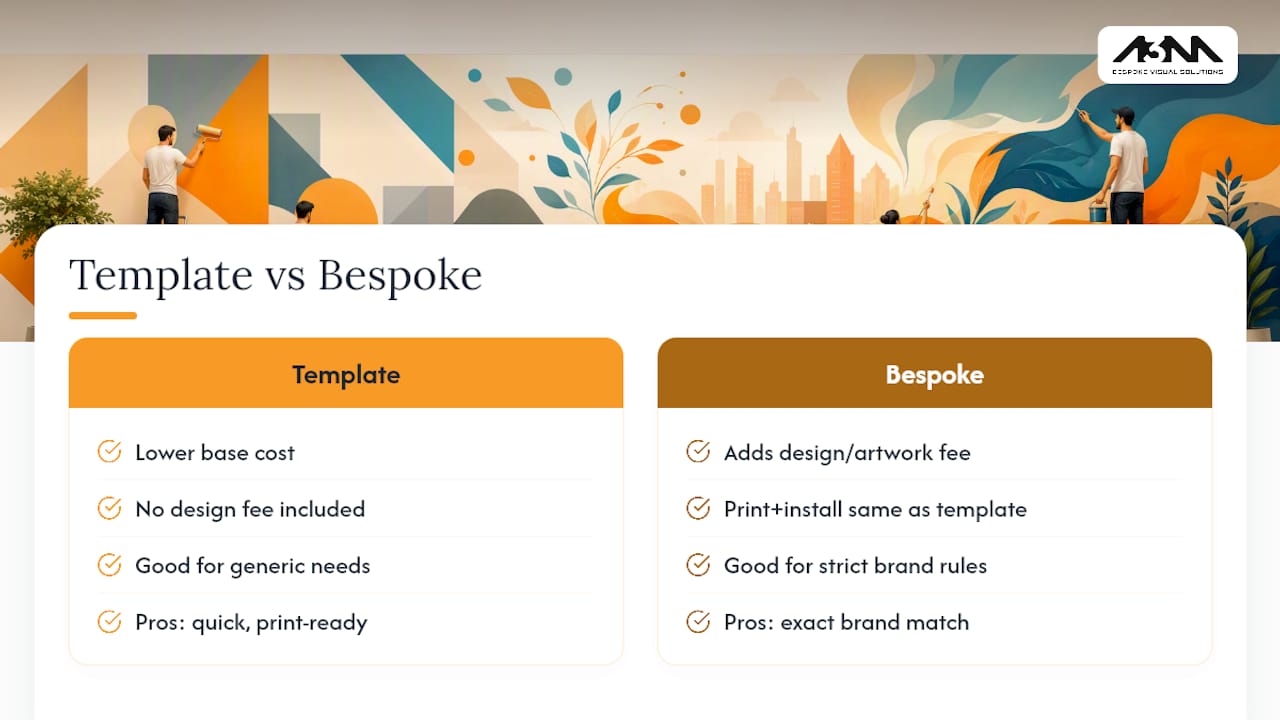
Ready-made or template graphics are, unsurprisingly, the cheaper route when you need something generic and don’t have brand-specific requirements. A stock nature scene, an abstract pattern, or a pre-designed motivational typography piece can be printed and fitted without any design time built into the price, since the artwork already exists in print-ready form.
Bespoke design work changes the cost picture in one specific way: it adds a design or artwork fee on top of the print and installation cost, rather than making the print itself more expensive. That fee typically covers concept development, brand colour matching, file preparation for large-format output, and at least one round of proofing. For a business wanting its exact brand palette, logo integration, or a custom illustration reflecting a specific space, this is usually the only realistic option, since a template can rarely match a brand guideline precisely.
The gap narrows considerably if you already have finished, print-ready artwork from an in-house designer or agency. In that case, a “bespoke” job costs close to the same as a template one, because the supplier’s job is simply reproduction and fitting rather than creation. The false economy to watch for is choosing a template because it looks cheaper, then paying for revisions to make it fit your brand anyway, at which point you’ve paid twice: once for the template licence, once for the changes.
For most commercial clients, particularly in hospitality and retail where brand consistency matters, the bespoke route pays for itself through a result that actually matches the rest of the space. A3m’s guide to large-format print covers the production side of this in more detail.
Do special finishes like metallic or textured surfaces cost more?
Yes, and the increase is usually proportional to how much the finish changes the standard production process. A flat matt or gloss laminate over standard printed vinyl adds a modest amount to the base panel price and is one of the most common upgrades for high-traffic corridors, since it protects the print from scuffing and light abrasion.
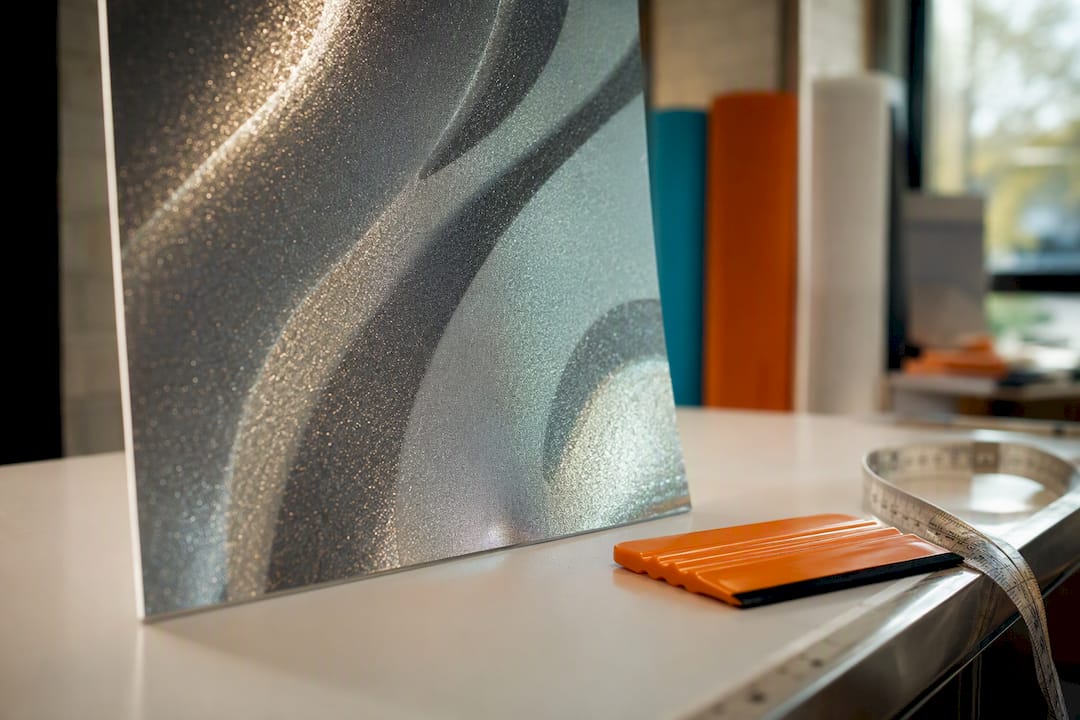
Metallic and textured finishes cost more because they typically require a different substrate entirely, not just a different coating. Textured wallcoverings that mimic fabric, brushed metal or concrete need specialist material stock, which costs more to buy in and is often only available from a narrower range of manufacturers. Metallic finishes, whether a foil-effect laminate or a genuine metallic substrate, add cost partly for the material and partly because colour proofing against a reflective surface takes more care to get right.
Class O fire-rated finishes, required in many public buildings, schools and escape routes, sit in a similar bracket: not dramatically more expensive per m², but noticeably above standard PVC vinyl, and worth confirming early if your building falls under stricter fire regulations. The practical advice here is to specify any required finish before you request quotes, rather than after, since switching substrate midway through a project often means re-quoting the whole job rather than a simple add-on.
Complex multi-panel designs that need precise pattern matching across joins also add cost, not because the print itself is harder, but because installation takes longer and mistakes are less forgiving.
Are sustainable wall graphics materials more expensive?
Sustainable material options have narrowed the price gap with standard substrates considerably, and for many jobs there’s now little practical difference. PVC-free vinyl alternatives, recyclable wallpaper stocks and water-based ink printing are increasingly offered as standard by UK large-format suppliers rather than as a premium add-on.
Where a genuine cost difference remains, it tends to sit with specialist substrates: fully recyclable or biodegradable wallcoverings, and materials certified to specific environmental standards for public sector procurement, can carry a modest premium over standard PVC vinyl. This is usually a material cost difference rather than an installation one, since fitting time is broadly comparable across most substrates.
For organisations with sustainability commitments, particularly local authorities, education clients and hospitality brands with environmental policies, the more relevant cost consideration is often longevity rather than the sticker price. A durable, well-fitted sustainable wallpaper that lasts 10 to 15 years works out cheaper over its lifetime than repeatedly replacing a shorter-lived budget option. A3m’s sustainable print solutions are built around this kind of lifecycle thinking rather than treating eco materials as a separate, pricier tier.
What other costs sit inside a wall graphics quote?
A headline “per panel” or “per m²” figure rarely captures every cost in a real project, and unbundling the components helps you spot where quotes genuinely differ.
Design fees cover concept work, brand-colour matching and layout for bespoke jobs, typically charged as a separate line rather than folded into the print price. Artwork creation or licensing applies if you need original illustration work, or if you’re licensing stock photography or an artist’s design for reproduction. Some suppliers include a set number of proof rounds within the design fee; further changes are usually billed separately.
Installation covers labour, access equipment and any specialist tools needed for the substrate. Removal of old graphics, often overlooked until a refit is booked, can add a meaningful sum if the previous material was poorly applied or has been up for years, since stripping degraded vinyl or adhesive residue takes longer than fitting new material. Warranty and after-care, such as a call-out to fix a lifting edge, is sometimes included for a defined period and chargeable afterwards.
Getting a single quote that itemises each of these, rather than one bundled figure, makes it far easier to compare suppliers fairly and to spot which one has quietly left something out.
Common pitfalls that push wall graphics budgets over
Scope creep is the biggest budget-wrecker: adding an extra wall, upgrading to a laminate finish, or discovering damp behind old wallpaper after the job’s already been priced. Wallpaper suits large continuous runs; fabric suits leased spaces you’ll need to reinstate. Bring your supplier in early, before the budget is fixed, not after.
— Steve
Get a bespoke wall graphics quote from A3m
A3m runs its own in-house production, meaning your wall graphics come from a single UK team rather than a chain of subcontractors, which is usually the fastest route to a firm price and a firm date. That matters most when you’re comparing quotes and finding the numbers vague: A3m offers a site survey, full UK installation, and sustainable material options as standard, so what you’re quoted is what you actually pay.

To get a quick, accurate quote, send over your wall measurements, a couple of photos of the surface, your preferred material if you have one, and your target installation date. If you want to see finishes and past projects before deciding, the A3m gallery is worth a look, and the large-format print manufacturing overview explains the in-house capability behind every quote. Get in touch with your details and A3m will come back with a clear, itemised price.
Sources
- Printed Wall Graphics | UK Custom Office Wall Graphics & More | UK Sign Shop
- School wall graphics costs in the UK for 2026 | Cubed Creative
- 3M application guidelines: applying graphics to walls