

For most UK restaurants and cafés, the printed signage that delivers the greatest return breaks down into seven core types: external fascia, illuminated fascia or halo letters, window graphics, an outdoor menu board, an A-board, internal menu and upsell boards, and wayfinding or branded wall graphics. Together, these cover visibility from the street, pre-entry browsing, in-venue upselling, and customer flow. To commission them efficiently, prepare your brand guidelines, site photographs, and a high-level budget before approaching a supplier. A3m provides bespoke signage with in-house manufacture, site surveys, and managed multi-site rollouts, so a single brief can take a venue from concept to installed sign.
Table of Contents
- What are the top signage solutions for restaurants and cafés?
- Which materials and finishes should you specify?
- How should you plan maintenance and sign lifecycle?
- How do you run a single-site or multi-site signage rollout?
- What questions should you ask a signage supplier?
- How does A3m deliver value for restaurants and cafés?
- Key takeaways
- From the team: what we have learned on UK hospitality projects
- A3m’s signage services for hospitality groups
What are the top signage solutions for restaurants and cafés?
The right combination of printed signs depends on your trading hours, street position, and menu complexity, but most venues share a common core. Here is the shortlist with purpose and indicative UK budget ranges:
- Window graphics — promotions, privacy screening, or seasonal campaigns; removable vinyl or frosted film; often costs a few hundred pounds per window.
Venue-type examples. A high-street café typically needs an illuminated fascia, A-board, window graphics, and a printed outdoor menu board. A suburban bistro with daytime-only trading can often rely on a non-illuminated fascia, projecting sign, and internal menu boards. A late-night restaurant benefits most from illuminated halo letters, window graphics, and strong wayfinding inside.
Which materials and finishes should you specify?
Substrate choice determines lifespan, maintenance burden, and finish quality. The table below covers the most common options in hospitality signage.
| Substrate | Typical lifespan | Best for | Key advantage | Watch out for |
|---|---|---|---|---|
| Aluminium composite (ACM/Dibond) | 10 years | External fascias, menu boards | Rigid, lightweight, weather-resistant | Requires professional fixing |
| Acrylic | 7 years | Illuminated faces, internal plaques | High-gloss finish, colour-stable | Brittle if thin; avoid high-impact areas |
| Stainless steel | 15+ years | Premium entrance plaques, wayfinding | Extremely durable, premium look | Higher cost; heavier fixing requirements |
| Treated timber | 5 years | Rustic or heritage venues | Warm aesthetic, paintable | Requires annual sealing in wet climates |
| Foamex (PVC foamboard) | 3–5 years | Internal displays, temporary works | Low cost, lightweight | Not suitable for outdoor long-term use |
| Cast or cut vinyl | 5–7 years (outdoor) | Window graphics, wall branding | Versatile, removable grades available | UV degradation without laminate |
Outdoor sign materials and their lifespans vary considerably by location. Coastal or high-pollution sites shorten the lifespan of most substrates by 20–30%, so specify marine-grade fixings and UV-stable inks as a baseline.
Specialist finishes worth requesting include halo or edge illumination for built-up letters, anti-graffiti coatings for street-level graphics, matt aqueous lamination for printed panels, and metallic foil or textured timber finishes for premium interior branding.
Pro Tip: For any sign within 500 metres of the coast or in a heavily trafficked urban area, specify grade-316 stainless fixings and ask your supplier to confirm the ink system is UV-stable to ISO 11798 or equivalent. It adds little to the unit cost and can double the effective outdoor lifespan.
How should you plan maintenance and sign lifecycle?
| Sign type | Cleaning frequency | Service tasks | Typical lifespan |
|---|---|---|---|
| External fascia (ACM) | Quarterly | Check fixings, clean face | 10 years |
| Illuminated fascia | Quarterly + annual electrical check | Replace failed LEDs, reseal edges | 7 years (face); LEDs 50,000+ hours |
| Window vinyl | Monthly wipe-down | Replace lifted edges; full refresh every 3–5 years | 5–7 years |
| A-board | Weekly wipe | Replace printed insert seasonally | Frame 5 years; inserts as needed |
| Internal menu boards | Monthly | Clean surface; reprint panels on menu change | 5 years |
| Foamex internal displays | Monthly | Replace if warped or marked | 3–5 years |
| Hoardings | As needed | Check structural fixings after high winds | Temporary; typically 6 months |
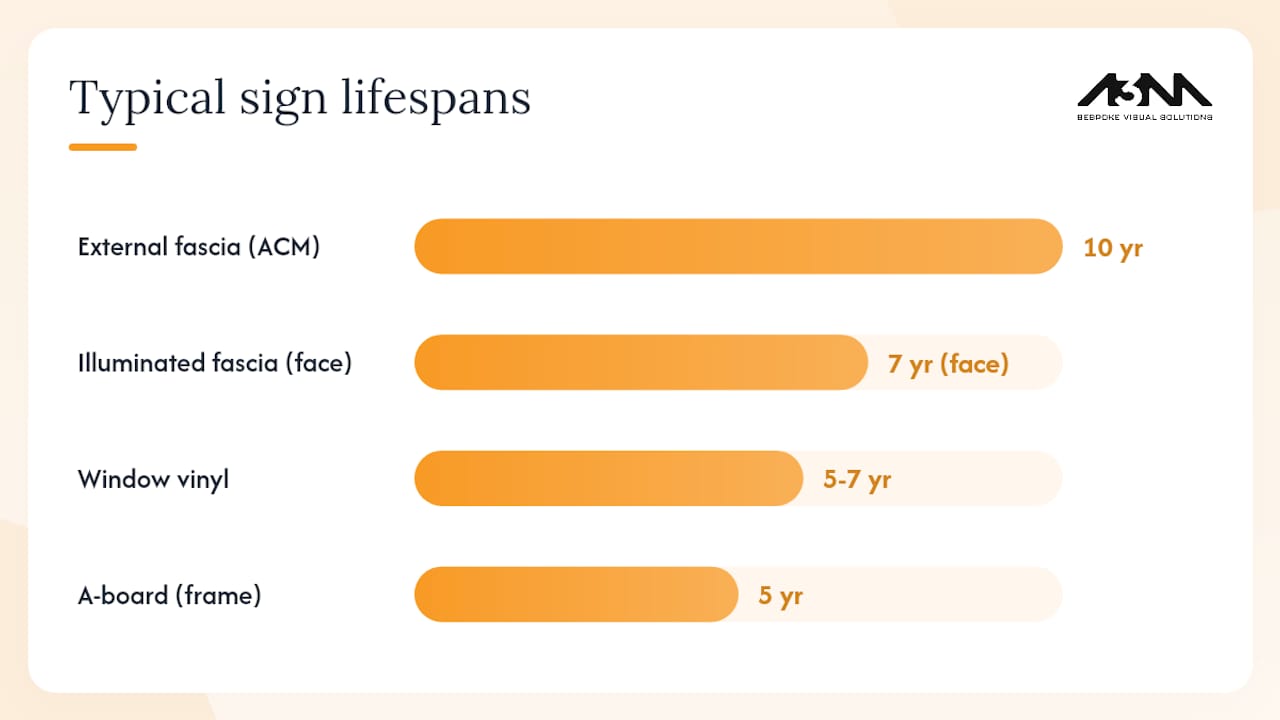
Plan replacement rather than repair when you see fading beyond brand-colour tolerance, structural corrosion at fixing points, or LED failure across more than 15% of an illuminated panel. Negotiate warranty terms of at least two years on manufacture and one year on installation workmanship when briefing suppliers.
Pro Tip: Specify anti-graffiti coating on all street-level graphics and ask for sacrificial film on window vinyls in high-footfall locations. Replaceable panel systems for menu boards mean you update messaging without replacing the full frame, which cuts long-term costs considerably.
How do you run a single-site or multi-site signage rollout?
The procurement model you choose shapes both cost and speed. For a single site, a project-based quote covering survey, manufacture, and installation is straightforward. For groups of three or more sites, a framework agreement or managed fulfilment model with a web-to-print portal reduces per-site admin and keeps brand consistency tight across locations.
A typical single-site timeline runs: site survey (week 1), design approval (weeks 1–2), manufacture (weeks 2–4), delivery and installation (week 5). Parallel-tracking design and planning consent applications compresses overall lead time. For multi-site rollouts, staggered installation windows and a central brand asset library managed through a web-to-print portal mean individual site managers order approved artwork without involving the central marketing team each time.
Structure your supplier brief to include: brand guidelines (fonts, colours, logo files), site photographs (frontage, interior, window dimensions), access constraints (restricted hours, scaffolding requirements), preferred installation windows, and a clear sign-type priority list.
What questions should you ask a signage supplier?
A thorough quote protects you from scope creep and installation-day surprises. Request the following before signing off:
- Site survey report with measurements and photographs
- Technical drawings showing fixing positions and structural loads
- Material samples or physical mockups for approval before manufacture
- Warranty terms covering manufacture and installation workmanship separately
- Public liability insurance certificate (minimum £5 million)
- Method statements and risk assessments (RAMS) for installation
- Electrical installation certificate for any illuminated signs
- Fixed-price installation quotation with named access method (cherry picker, scaffold, MEWP)
- Confirmation of who applies for Advertisement Consent and the associated fee
Red flags to watch for: vague lead times with no milestone dates; missing insurance or electrical certification; no sample approval stage; inconsistent material specifications between quote and drawings; open-ended installation charges described as “subject to access.”
Budget for optional extras that are frequently omitted from headline quotes: planning application fees (£462 in England), scaffolding or MEWP hire, electrical supply works, and landlord consent administration.
How does A3m deliver value for restaurants and cafés?
A full-service supplier with in-house manufacture removes the coordination risk that comes from splitting print, fabrication, and installation across separate contractors. A3m handles the complete project flow: site survey, technical drawings, sample sign-off, manufacture, and co-ordinated installation. For multi-site operators, A3m’s web-to-print portal gives site managers access to pre-approved artwork and ordered fulfilment without central-team involvement on every job.
The signage best practices guide A3m publishes for hospitality clients reflects the kind of sector-specific knowledge that translates into fewer installation-day problems and more accurate quotes. Specialist finishes including foiling, halo illumination, and anti-graffiti coatings are produced in-house, which means shorter lead times and tighter quality control than outsourced alternatives.
Key takeaways
Bespoke printed signage for UK restaurants and cafés requires the right substrate, a clear planning checklist, and a supplier who can manage manufacture, installation, and multi-site rollouts under one roof.
| Point | Details |
|---|---|
| Prioritise seven core sign types | External fascia, illuminated letters, window graphics, menu board, A-board, internal upsell boards, and wayfinding cover most venues. |
| Specify materials and warranties | ACM and acrylic outlast foamex outdoors; always negotiate a two-year manufacture warranty and one-year installation warranty. |
| Budget for planning consent | Advertisement Consent in England costs £462 per site and takes around eight weeks — include both in your project timeline. |
| Use managed fulfilment for multi-site | Web-to-print portals reduce site-level admin and maintain brand consistency across all locations. |
| A3m as your supplier | A3m offers in-house manufacture, site surveys, sample approvals, and managed rollouts for UK hospitality groups. |
From the team: what we have learned on UK hospitality projects
The single most common cause of budget overrun on hospitality signage projects is not the sign itself. It is the access. A fascia that looks straightforward from the pavement often sits above a listed shopfront, requires a MEWP on a restricted highway, or needs landlord consent that takes three weeks to arrive. The projects that run smoothly are the ones where the site survey happens before the quote is finalised, not after.
Standardising fixings, panel sizes, and substrate specifications across a multi-site rollout saves more money than negotiating on unit price. When every site uses the same ACM thickness and the same fixing centres, replacement panels can be manufactured in batches and installed by any qualified team on the framework, without a bespoke survey each time.
One practical tip: ask your supplier to photograph every installation on the day and log the fixing specification. That record is worth its weight when a panel needs replacing two years later and the original installer is unavailable.
A3m’s signage services for hospitality groups
A3m works with UK restaurant and café groups to deliver printed signage from brief to installation, with in-house manufacture that keeps quality and lead times under control. The service covers external fascias, illuminated signs, window graphics, POS displays, wayfinding, hoardings, and multi-site managed fulfilment through a web-to-print portal. Sustainability options including PVC-free substrates and low-VOC inks are available on request, with material declarations provided as standard.

To start, send A3m your brand guidelines, site photographs, and a rough priority list of sign types. The team will book a site survey, prepare sample sign-offs, and return a fixed-price quote with a clear installation timeline. For multi-site operators, ask about framework agreements and web-to-print setup.
Get in touch via the A3m signage page to request a survey or framework quote. We love to chat through the brief before anything is committed to paper.