

For UK attractions, the print solutions that deliver the most commercial and experiential value are: large-format wayfinding and directional signage, durable outdoor hoardings and exterior panels, interpretive and exhibition displays, modular exhibition stands, retail and POS print (merchandise, shelf-talkers, hangers), accessible printed materials (large print, braille, BSL-supported formats), and web-to-print portals for multi-site fulfilment. A3m is the recommended project-ready partner for all of these, with in-house large-format manufacturing, sustainable substrate options, and managed fulfilment across the UK.
Quick reference:
- Lead times: 3–7 working days for short-run collateral; 7–21 working days for large-format panels; 3–8 weeks for modular exhibition stands
- Typical cost bands: £150–£600 for brochure and leaflet runs; £500–£3,500+ for large-format signage; £3,000–£15,000+ for modular exhibition stands (see the full table in the implementation section)
- First step: Contact A3m to request a sample pack and site-audit consultation before committing to a full production run
Pro Tip: Before briefing any supplier, photograph every visitor decision point on your site, from the car park entrance to the gift shop exit. That ten-minute walk-through will shape your entire signage brief and prevent costly rework later.
Key takeaways
The most effective print strategy for UK attractions combines accessible, durable large-format signage with sustainable substrates, a web-to-print portal for ongoing fulfilment, and a supplier with in-house manufacturing capability.
| Point | Details |
|---|---|
| Print drives real bookings | Over half of leaflet recipients are more likely to visit; home-delivered leaflets show a 13% ticket conversion rate. |
| Accessibility is non-negotiable | Offer large print (16–18pt), braille, audio, and easy-read formats; make your Accessibility Guide prominent on your homepage. |
| Sustainable options exist for outdoor use | Recycled ACM, FSC-certified board, PET-recycled foamex, and UV-curable inks all perform outdoors without sacrificing durability. |
| Plan lead times early | Large-format hoarding panels take 10–21 working days; full wayfinding schemes can run to 8 weeks. Budget accordingly. |
| A3m for attraction print projects | A3m offers in-house large-format manufacturing, accessible design, sustainable substrates, and web-to-print portals for UK attractions. |
Table of Contents
- Why does high-quality print still matter for visitor experience?
- What are the top print solutions for tourism attractions?
- How do you make attraction print materials genuinely accessible?
- Which sustainable print options work for outdoor attraction use?
- How do you choose the right print supplier for your attraction?
- What are realistic lead times and costs for attraction print projects?
- What print projects for attractions actually teach you
- A3m delivers print solutions built for UK attractions
- Sources
Why does high-quality print still matter for visitor experience?
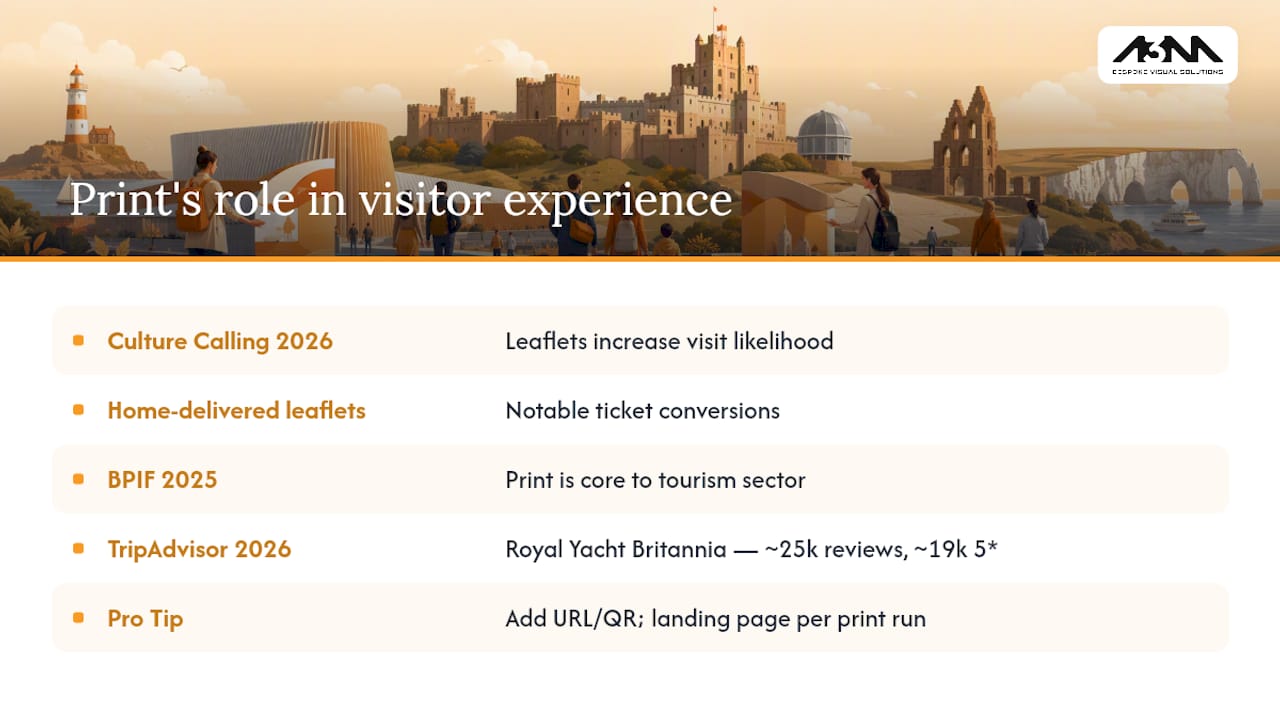
Print is not a legacy channel for attractions. Culture Calling’s 2026 research found that receiving a leaflet made many respondents more likely to visit, and home-delivered leaflets produced a notable ticket conversion rate. Those are commercial outcomes that most digital-only campaigns struggle to match at equivalent cost.
The British Printing Industry Federation’s 2025 facts and figures confirm that print serves travel and tourism alongside retail and government as one of its core sectors. The medium carries trust in a way that a social media post rarely does, particularly for first-time visitors deciding whether an attraction is worth the journey.
Visitor reputation matters enormously here. Tripadvisor’s 2026 Travellers’ Choice rankings placed the Royal Yacht Britannia as the world’s top attraction, and TimeOut’s coverage noted that the attraction accumulated roughly 25,000 TripAdvisor reviews with nearly 19,000 perfect scores. Presentation and interpretation quality feed directly into those ratings.
Print and digital are not rivals. Print sparks discovery and builds intent; digital completes the transaction. A well-placed leaflet in a hotel lobby or a striking hoarding at a motorway services drives someone to search, click, and book.
Pro Tip: Add a short, memorable URL or QR code to every printed piece. Keep the landing page specific to that print run so you can track exactly how many bookings each campaign generates.
What are the top print solutions for tourism attractions?
The IBISWorld 2026 UK printing industry overview covers the full range of products available, from short-run digital brochures to large-format signage and labels. For attractions specifically, the most productive investment categories are below.
| Solution type | Visitor journey stage | Recommended substrate/material | Minimum spec | Accessibility note |
|---|---|---|---|---|
| Wayfinding and directional signage | Arrival and orientation | Aluminium composite (ACM), 3mm | 600 × 400mm, anti-glare laminate | Minimum 28pt sans-serif, high-contrast, public information symbols |
| Exterior hoardings and banners | Pre-arrival and arrival | PVC mesh or blockout, UV inks | large-format outdoor panels | Large text, pictograms, avoid decorative fonts |
| Interpretive and exhibition panels | Interpretation | Foamex, ACM or recycled board | A1 minimum, 150 dpi at final size | 18pt body text, 4.5:1 contrast ratio |
| Modular exhibition stands | Events and touring exhibits | Fabric tension or aluminium frame | 2m × 1m minimum bay | Tactile labels available; BSL video QR codes |
| Retail and POS displays | Retail and departure | Correx, foamex, card | Shelf-talker: A5; floor display: A1 | Clear pricing, pictograms, legible at arm’s length |
| Printed maps and brochures | Orientation and take-home | FSC-certified silk or uncoated | A4 folded, 150gsm minimum | Large-print version at 16–18pt; easy-read option |
| Accessible printed materials | All stages | Uncoated or tactile stock | A4 minimum | Braille, large print 16–18pt, easy-read layout |
For A3m’s signage services, durable finishes include anti-graffiti laminates, R10-rated anti-slip substrates for wet outdoor sites, UV-curable inks for colour stability, and foiling or embossing for premium retail and wayfinding applications.
Web-to-print portals are particularly useful for attractions with multiple sites or seasonal gift shops. A centralised portal lets your team order pre-approved artwork, manage seasonal rollouts, and maintain brand consistency without involving a designer for every reprint.
Pro Tip: For high-touch areas such as ticket desks and interactive exhibits, specify an anti-graffiti overlaminate and build a quarterly inspection into the purchase order. Replacing a single damaged panel costs far more than a maintenance schedule.
How do you make attraction print materials genuinely accessible?
Accessibility is not optional. The VisitBritain guidance for attractions recommends publishing a detailed Accessibility Guide and offering alternative formats including large print (at least 16–18pt), audio, and easy-read versions. Visitors who cannot find clear access information before they arrive often do not come at all.
Practical accessibility checklist for printed materials and signage:
- Use a minimum 28pt sans-serif typeface (Arial, Helvetica, or Johnston) on all wayfinding signs.
- Maintain a contrast ratio of at least 4.5:1 between text and background on all printed panels.
- Avoid decorative, script, or condensed fonts on any visitor-facing material.
- Use internationally recognised public information symbols alongside text on directional signs.
- Produce a large-print version of every brochure and map at a minimum of 16–18pt body text.
- Offer a braille version of your site map and key visitor information.
- Provide audio-described recordings of interpretive content, with BSL-subtitled video accessible via QR code.
- Include tactile models or raised-relief maps at key orientation points for visitors with visual impairments.
- Audit all printed materials annually against this checklist and update before peak season.
- Make your Accessibility Guide prominent on your homepage and in the booking flow, not buried in a footer.
Aligning your printed Accessibility Guide with your virtual tour accessibility features ensures that visitors who research your site digitally find consistent information when they arrive in person.
Pro Tip: Place your Accessibility Guide link in the primary navigation of your website, not just on a dedicated accessibility page. Visitors using screen readers or planning tools will find it faster, and VisitBritain specifically recommends this prominence.
Which sustainable print options work for outdoor attraction use?
Sustainable substrates and low-impact inks are available without sacrificing the durability outdoor attraction signage demands. The options below are practical for UK weather conditions and meet growing procurement sustainability requirements.
- Recycled aluminium composite panels: structurally equivalent to standard ACM, with a recycled aluminium core; suitable for permanent exterior wayfinding.
- FSC-certified board and paper stocks: for brochures, maps, and interpretive panels; certifies responsible forest management across the supply chain.
- PET-recycled foamex alternatives: rigid display boards made from post-consumer recycled PET; lighter than standard foamex and recyclable at end of life.
- Eco-solvent and UV-curable inks: lower VOC emissions than conventional solvent inks; UV-curable inks bond without solvents and offer excellent outdoor colour stability.
- Vegan and solvent-free laminates: available for brochures and panel overlaminates; reduce chemical load and are compatible with recycling streams.
- Modular panel systems: designed for reuse across seasons or touring exhibits; replace individual panels rather than the entire structure, reducing waste significantly.
- Take-back and repair-first schemes: ask your supplier whether they offer panel repair or substrate take-back at end of campaign.
Culture Calling’s research found that 76% of people retain print, which means a well-produced, sustainably printed brochure or map continues working long after a digital ad has scrolled past. Investing in durable, recyclable substrates extends that lifespan further and reduces the frequency of reprints.
How do you choose the right print supplier for your attraction?
Pick a partner with in-house manufacturing, demonstrable experience with attractions, clear accessibility and sustainability credentials, and the fulfilment capability to handle multi-site or seasonal rollouts. The YDNPA signage specification recommends conducting site audits by observing natural visitor behaviour without branded staff present, then planning sign families with clear installation notes and maintenance schedules. That approach applies equally when briefing a commercial print supplier.
Capability questions to ask any supplier:
- Do you manufacture in-house, or do you outsource production?
- What are your standard lead times for large-format panels and modular stands?
- Can you provide sample panels for substrate and finish approval before full production?
- Do you offer on-site installation and a post-installation maintenance plan?
- What sustainability certifications or reporting can you provide (FSC, ISO 14001)?
- Have you delivered projects for visitor attractions or heritage sites? Can you share case studies?
- Do you offer a web-to-print portal for ongoing multi-site orders?
Procurement red flags:
- No local or sector references available
- Unwilling to provide physical sample panels before sign-off
- Vague or unconfirmed lead times at point of quotation
- No maintenance or repair plan offered post-installation
- Sustainability claims with no certification or documentation
Project checklist before briefing:
- Scope: number of signs, panel sizes, quantities, and locations
- Materials spec: substrate, finish, mounting method, and weather exposure rating
- Installation: access requirements, fixing type, and groundworks if needed
- Maintenance plan: inspection schedule and panel replacement process
- Accessibility checks: contrast ratios, font sizes, alternative formats required
- Pricing and contingency: agree a cost band and a 10–15% contingency for bespoke items
Request a project portfolio and on-site installation photos. A supplier who has delivered for a heritage site, museum, or outdoor attraction will understand the constraints that a generic commercial printer will not.
Pro Tip: Ask for a pre-production sample trial of any new substrate and finish combination. Install a single prototype panel for a week to test light, reflection, and visitor interaction before committing to a full production run.
What are realistic lead times and costs for attraction print projects?
Lead times vary by complexity, substrate, and installation requirements. The figures below are indicative for UK production in 2026.
Bespoke substrates, complex finishes (foiling, embossing, anti-graffiti), site surveys, and installation scheduling all extend lead times. Plan for the longer end of any range when your project involves outdoor installation or heritage site restrictions.
Ways to reduce lead times and costs:
- Use standardised templates for recurring collateral (seasonal leaflets, shelf-talkers)
- Consolidate multi-site orders into a single production run via a web-to-print portal
- Schedule large-format signage outside peak season to avoid production bottlenecks
- Agree a framework agreement with your supplier for annual or seasonal reprints
What print projects for attractions actually teach you
The projects that succeed share one thing: a clear brief written before anyone opens a design file. Attractions that arrive with a site map, a visitor flow diagram, and a list of accessibility requirements get better results, faster, and at lower cost. Those that brief on the fly spend the budget on revisions.
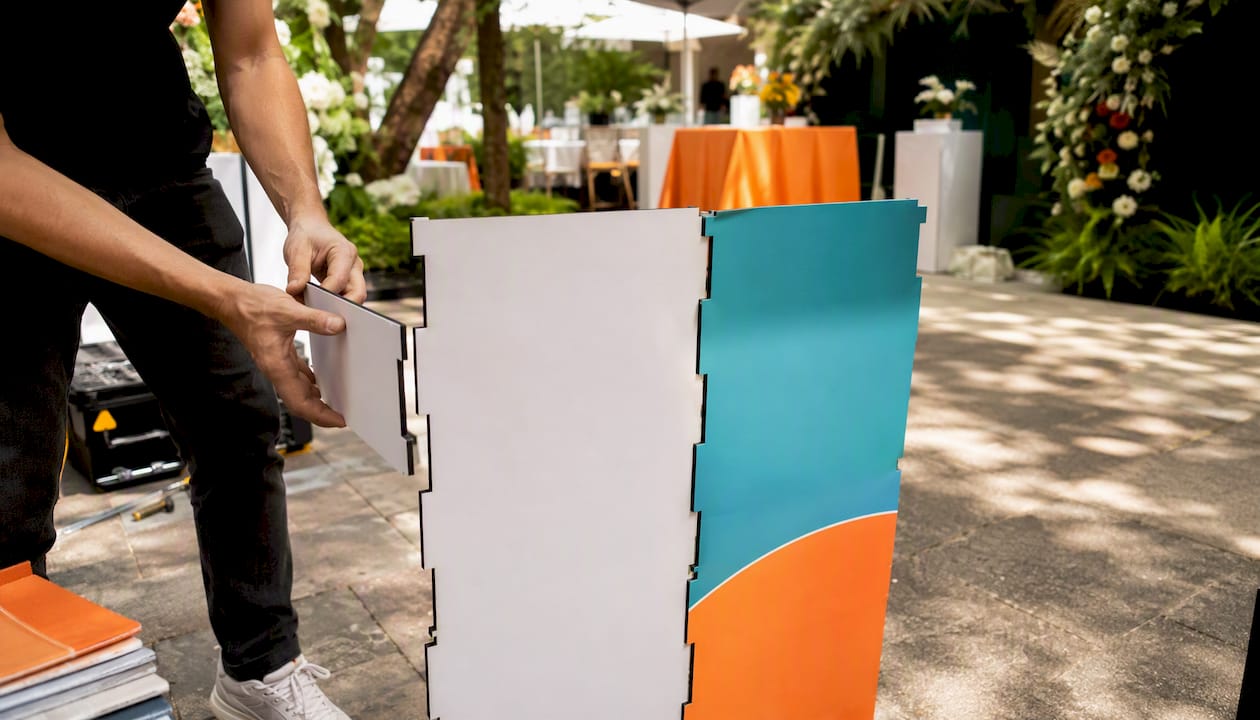
Two lessons stand out from delivering print for UK attractions. First, early site audits prevent installation delays. Knowing that a particular wall receives direct afternoon glare, or that a mounting point sits within a listed building’s protected zone, changes the substrate and fixing specification entirely. Second, modular systems save money over time. An attraction that invests in a modular exhibition stand or a panel system with interchangeable graphics will spend less on reprints over three years than one that commissions bespoke one-off panels each season.
A web-to-print portal removes the single biggest source of ongoing friction for multi-site attractions: the back-and-forth over artwork approval. When pre-approved templates are available in a portal, your retail team can reorder seasonal merchandise or replace a damaged wayfinding panel without involving the marketing department or a designer. That is not a minor convenience; it is the difference between a panel being replaced in three days and it staying damaged for three weeks.
A3m delivers print solutions built for UK attractions
A3m works with marketing and operations managers who need more than a printer. With in-house large-format manufacturing, A3m handles everything from wayfinding signage and interpretive panels to modular exhibition stands and retail POS displays, all produced and quality-checked under one roof. Sustainable substrates, accessibility-aware design, and managed installation are part of the service, not extras.

Whether you need a full site signage scheme, a seasonal brochure run, or a web-to-print portal for your gift shops, A3m can scope the project, provide sample panels, and confirm lead times before you commit. Get in touch with the team at A3m to request a sample pack or arrange a site-audit consultation.
Sources
- Tripadvisor mediaroom — Best of the Best Things To Do 2026
- VisitBritain — Top20 tips for attractions (Accessibility guidance)
- Culture Calling — Print still drives attention and action in a digital age (2026)
- British Printing Industry Federation — UK printing facts & figures (2025)
- TimeOut — The world’s best attraction is here in the UK (2026-04-28)