

Soft touch lamination is a thin polymer film with a micro-textured coating that gives paper or board a velvet-like feel, and it’s the fastest way to signal premium quality on packaging or brochures. It suits inner boxes, folding cartons and presentation collateral that people handle and admire. The trade-off: that same soft surface shows scuffs and fingerprints more readily than gloss or standard matte, so it’s the wrong choice for anything travelling loose in a delivery van.
TL;DR:
- Soft touch lamination is best suited for inner boxes, folding cartons, and presentation materials that are handled frequently and need a tactile luxury impression.
- Its vulnerability to scuffs and fingerprints makes it unsuitable for shipping cartons, heavily handled retail displays, or environments with rough transit.
- Achieving optimal results requires matching film thickness, substrate weight, and finishing sequence, with proofs essential to ensure color accuracy and texture.
- The added cost ranges from $0.08 to $0.60 per unit, influenced by coverage area, run length, and additional finishing processes like foil or embossing.
- Advances in recyclable and durable formulations are emerging but do not eliminate the need for careful handling, storage, and pre-production testing to prevent common defects.
Table of Contents
- What is soft touch lamination and how does it differ from matte and gloss?
- Why designers and brands choose soft touch
- When soft touch lamination is the wrong choice
- Technical specifications and production considerations
- What does soft touch lamination cost per unit?
- How to specify soft touch lamination for a project
- A3M practitioner perspective on proofing and real production
- Maintenance and cleaning tips for soft touch laminated products
- Common issues and troubleshooting during the lamination process
- Advances and innovations in soft touch lamination technology
- Why soft touch still gets specified wrong
- Get your soft touch finish specified and produced properly
- Sources
What is soft touch lamination and how does it differ from matte and gloss?
Soft touch lamination uses a polymer film, usually PET or Biaxially-Oriented Polypropylene (BOPP), coated with a micro-textured layer that mimics suede or velvet under the fingertips. The film typically runs 12 to 18 microns thick, thin enough to keep the substrate flexible but dense enough to hold that tactile grip once bonded.
Two bonding methods dominate production. Thermal lamination fuses the film to the printed sheet using heat and pressure through a roller system, which most UK trade finishers run as standard. Adhesive lamination uses a wet or solvent-based bonding agent, better suited to certain heavier boards or when a thermal press isn’t available. Either way, the result behaves very differently to matte or gloss on press:
- Gloss reflects light directly, boosting colour saturation and giving that classic “shiny” print look.
- Standard matte scatters light evenly, flattening reflections and softening colour contrast slightly.
- Soft touch absorbs more light than either, deepening blacks and dark tones while producing almost no reflection at all, which is why it reads as so much more expensive under retail lighting.
That light absorption is doing more work than people assume. It’s not just texture. Dark, high-coverage artwork genuinely looks richer under soft touch than under a standard matte laminate, which is exactly why so many premium beauty and spirits brands specify it for outer sleeves.
Why designers and brands choose soft touch
Soft touch lamination earns its keep at the unboxing moment. It’s the finish that makes a customer pause and run their hand across a box before they open it, and that tactile pause is doing genuine commercial work: soft touch delivers a stronger perception of premium value than matte in many direct-to-consumer and beauty contexts, often for only a modest per-unit increase.
It also plays exceptionally well with other finishing techniques. Foil stamping against a soft touch background creates a striking contrast between matte softness and metallic sheen, and embossing reads far more three-dimensional when the surrounding surface absorbs light rather than reflecting it. Designers should factor that combination into the finishing budget early, since stacking foil or emboss onto soft touch adds to the total per-unit cost.
The applications where this finish earns its premium:
- Inner boxes and rigid presentation cartons that get picked up and inspected.
- Folding cartons for beauty, spirits and confectionery where shelf appeal drives the sale.
- Premium brochures, portfolios and presentation folders handed over in client meetings.
Pro Tip: If you’re combining soft touch with foil, ask your finisher to run the foil stamp after lamination, not before. Foiling through the laminate film gives a cleaner edge and stronger metallic contrast than foiling the sheet first.
When soft touch lamination is the wrong choice
Soft touch has one well-known weakness: it marks. Anything that travels loose in transit, gets stacked in a warehouse, or passes through dozens of hands at a trade show will pick up visible scuffs faster on soft touch than on gloss or an anti-scuff matte laminate. That’s the finish showing scuffs and fingerprints more readily in heavy-contact retail environments than either alternative.
Dark colours make the problem worse. Fingerprints and scuff marks show up more clearly against deep, heavy-coverage inks, which is awkward given how often soft touch gets specified precisely because it deepens dark artwork. Protecting high-contact zones with a spot gloss or foil panel is the usual fix.
There’s a sustainability angle too. As a polymer film bonded to paper or board, soft touch laminate complicates recycling in the same way any plastic film lamination does, and mixed-material packaging generally needs specialist recycling streams rather than standard paper waste.
- Avoid soft touch on outer shipping cartons or anything handled roughly in distribution.
- Use spot gloss or foil to shield logos and text areas prone to fingerprint marks.
- Flag the recyclability question early if the brand has environmental packaging commitments.
Technical specifications and production considerations
Getting the technical brief right up front saves a reprint. Three variables decide how a soft touch job actually performs once it leaves the press, starting with the choice of paper roll supplier that ensures compatible and high-quality substrate availability.
- Film thickness. Most soft touch laminates run between 12 and 18 microns. Thinner films at the lower end feel softer and drape more naturally over flexible stock; thicker films add rigidity and slightly more scuff resistance, useful on folding cartons that need structural stiffness.
- Stock weight and substrate. Lamination films bond best to coated or uncoated stock above roughly 250gsm; lighter sheets can wrinkle or curl once film tension is applied. Checking your packaging board grade against the finisher’s minimum recommended weight avoids that problem before print run day.
- Finishing sequence. Foil stamping, embossing and spot UV should generally be applied after soft touch lamination rather than before, since the film needs a clean substrate to bond evenly. Discuss sequencing with your finisher at brief stage, not after plates are cut.
Getting this sequence backwards is one of the most common and expensive mistakes in premium packaging production.
What does soft touch lamination cost per unit?
Soft touch lamination typically adds between $0.08 and $0.60 per unit, and where you land in that range depends on format, coverage area and run length. A small folding carton with partial coverage sits at the lower end; a larger rigid box or full-wrap application with total surface coverage pushes towards the top of the range.
Set-up costs matter more than most buyers expect. Short runs absorb the fixed cost of tooling and press set-up across fewer units, so per-unit price drops sharply once a run passes a few thousand pieces. If you’re layering foil or embossing on top, budget that as a separate line: combining finishes raises the total per-unit cost beyond the lamination adder alone, sometimes substantially depending on foil coverage area.
How to specify soft touch lamination for a project
A clear brief prevents most soft touch problems before they reach the press. Work through this before you send artwork to a finisher:
- Define the touchpoint. Who handles this item, how often, and under what conditions? Match the finish to the touchpoint and transit conditions rather than choosing on looks alone.
- Map the journey. Inner packaging opened once at the counter behaves very differently to an outer carton stacked in a pallet for three weeks.
- Set the visual goal. Decide whether dark tone depth or foil contrast is the priority, since that shapes ink coverage decisions.
- Confirm the budget ceiling. Know your per-unit target before the quote arrives so you’re not choosing finishes you can’t afford at volume.
- Request colour compensation notes and a physical proof. Soft touch changes perceived saturation compared with a digital proof, so never approve final stock sight unseen.
Pro Tip: Ask your supplier one question before signing off: what rub-resistance grade does the film carry? A vague answer, or a supplier who can’t produce a physical sample on your actual stock, is a red flag worth walking away from.
Reviewing your large format print finish options alongside this checklist helps if you’re specifying finishes across a wider print run, not just packaging.
A3M practitioner perspective on proofing and real production
We always insist on a physical proof under the final stock and finish before committing to a full run. It’s the only reliable way to see how soft touch will actually behave on your artwork, since screens and digital mock-ups never show scuff risk or true colour depth.
We’ve applied soft touch across exhibition collateral and premium gift packaging, where the tactile lift consistently justifies the spend. On material choice, we weigh recyclability against durability needs project by project, steering clients towards the lightest film that still meets their handling requirements.
Maintenance and cleaning tips for soft touch laminated products
Soft touch surfaces need gentler handling than gloss, but they’re not fragile if you follow a few basics. Fingerprint oil is the main enemy, and it sits visibly on the surface rather than soaking in, so regular handling during storage or display gradually dulls the finish.
For everyday cleaning, a soft, dry microfibre cloth removes light dust and surface marks without abrading the texture. Avoid anything abrasive: paper towels, rough cloths and household cleaning sprays containing alcohol or ammonia can strip the micro-texture coating or leave permanent streaking. If a mark needs more than a dry wipe, a barely damp microfibre cloth followed immediately by a dry one usually lifts it without saturating the film.
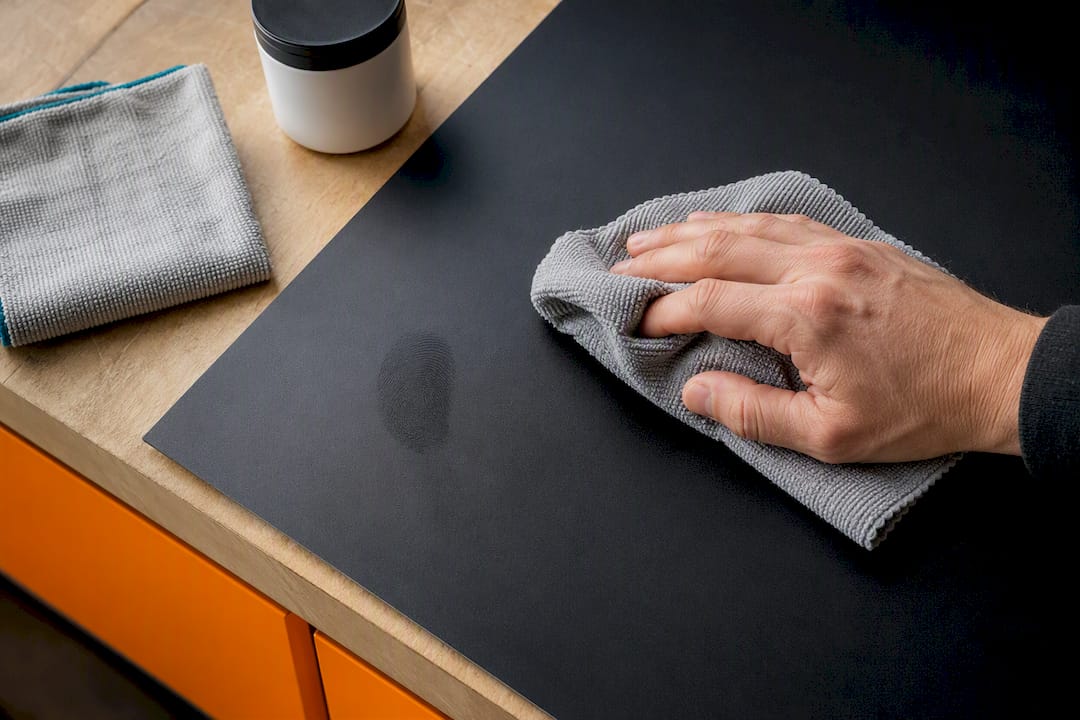
Storage conditions matter as much as cleaning technique. Keep finished stock flat, away from direct sunlight and humidity swings, since polymer films can react to heat by softening slightly, which makes them more prone to picking up marks from whatever they’re stacked against. Interleaving tissue between finished pieces during storage or transit is a simple habit that prevents surface-to-surface transfer marking, especially on dark artwork where every scuff is visible.
For point-of-sale displays or retail packaging that stays on shelf for weeks, brief your team or retail partner on basic care: no adhesive labels applied directly to soft touch panels (they can lift the coating on removal), and no stacking heavy items directly on laminated surfaces. These are small operational details, but they’re the difference between packaging that still looks premium after a month on shelf and packaging that looks tired within days.
Common issues and troubleshooting during the lamination process
Most soft touch problems trace back to one of three causes: substrate mismatch, sequencing errors, or moisture.
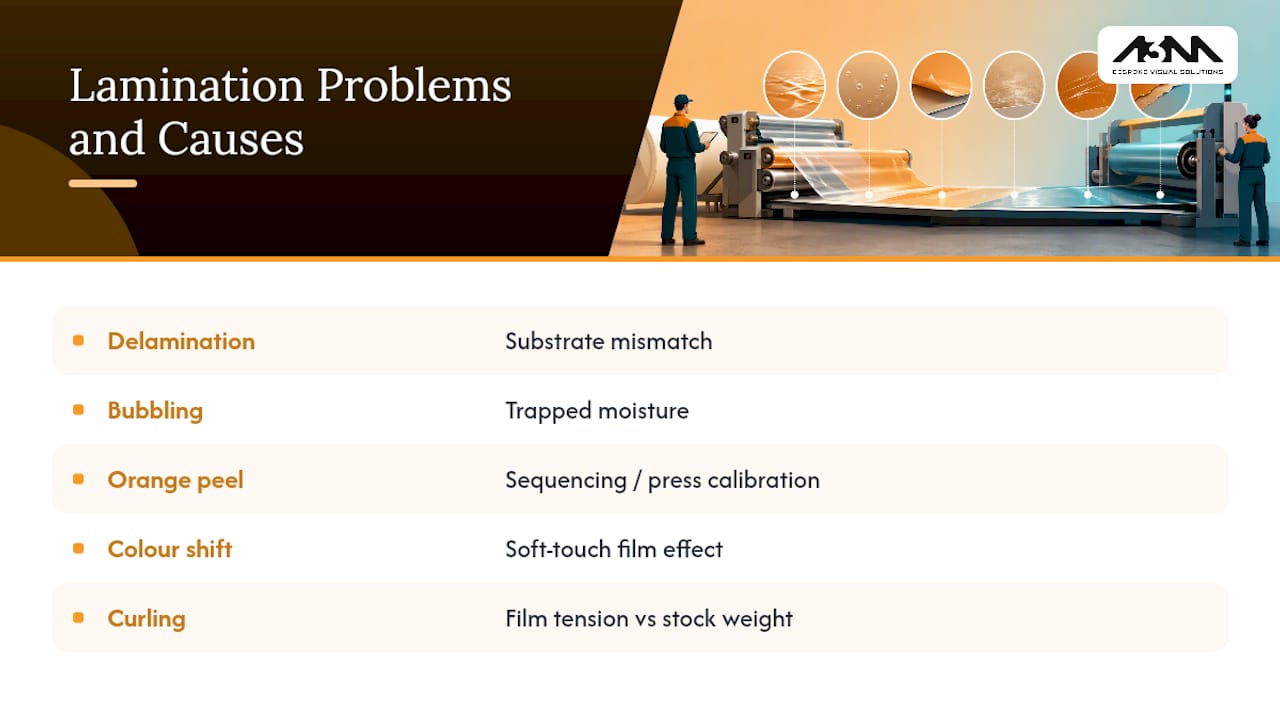
Delamination, where the film lifts or bubbles at the edges, usually points to insufficient stock weight or a substrate with a coating that resists adhesive bonding. If you’re seeing edge lift consistently, check your board grade against the finisher’s minimum recommended weight before blaming the film itself.
Orange peel texture, an uneven, dimpled surface rather than a smooth velvet finish, often results from incorrect roller temperature or pressure during thermal lamination. This is a press calibration issue on the finisher’s side rather than a film defect, and it’s exactly the kind of flaw a physical proof catches before a full run commits to it.
Colour shift is the most commonly reported surprise. Soft touch laminate darkens and mutes colours compared with how they appear on an uncoated proof, which is precisely why digital previews mislead buyers so often. Ink that looked vibrant on screen can read flat and heavy under soft touch, particularly with lighter pastel tones that lose some vibrancy under the film’s light-absorbing texture.
Curling after lamination, where sheets bow rather than lying flat, typically signals a mismatch between film tension and stock weight, more common on lighter substrates under 250gsm. Moisture is the other common culprit: stock stored in humid conditions before lamination can trap moisture under the film, leading to bubbling weeks after production that wasn’t visible at the time of finishing. Storing substrate in a controlled, dry environment before it reaches the press solves this more often than any adjustment to the lamination process itself.
Advances and innovations in soft touch lamination technology
The biggest shift in soft touch technology over recent years has been the push towards recyclable and bio-based films. Manufacturers have been developing polymer alternatives designed to biodegrade or integrate more easily into standard paper recycling streams, addressing the sustainability concern that has historically been soft touch’s biggest drawback against uncoated or varnished alternatives.
Anti-scuff and enhanced rub-resistance formulations are the other major development. These modified coatings aim to retain the velvet hand-feel while improving resistance to the fingerprint and scuff marking that has limited soft touch to lower-contact applications. Early versions trade off slightly on the ultimate softness of the texture, but for brands wanting the tactile signal on items that see more handling, the durability gain often justifies that small compromise.
Digital and hybrid finishing presses have also improved consistency. Newer thermal lamination lines offer tighter temperature and pressure control, reducing the orange peel and uneven bonding issues that plagued older equipment, particularly on shorter runs where a press hadn’t fully stabilised before the job began.
Water-based and low-solvent adhesive systems are gaining ground too, driven partly by environmental regulation and partly by brand demand for lower-impact production. These systems still achieve reliable bonding on most coated stocks, though they can be less forgiving on unusual substrates, which is worth flagging with your finisher if you’re specifying an uncommon board grade.
None of these developments have displaced the fundamentals. A physical proof still catches problems no innovation has fully solved, and thickness, substrate compatibility and finishing sequence still decide most outcomes.
Why soft touch still gets specified wrong
The conventional wisdom treats soft touch lamination as a purely aesthetic upgrade, something you add if the budget allows and skip if it doesn’t. That framing misses the point. Soft touch is a functional decision about who handles the item and how often, and treating it as a style choice is exactly how brands end up with scuffed, fingerprint-covered packaging within a week of hitting shelf.
The advice that gets underweighted most is the physical proof. Buyers routinely approve a digital mock-up and only discover the colour shift or the scuff pattern once the full run is printed and boxed. That’s an expensive lesson to learn twice, and it’s entirely avoidable for the cost of a single proof run.
If there’s one priority worth fixing first, it’s asking the transit and handling question before the aesthetic one. Where does this item travel, and who touches it between the press and the customer’s hands? Answer that honestly, and the choice between soft touch, matte or a hybrid anti-scuff finish becomes obvious rather than a guess made on mood boards.
— Steve
Get your soft touch finish specified and produced properly
A3M is the direct route to soft touch lamination done right, from film specification through to finish stacking with foil or embossing, all handled in-house rather than passed between subcontractors. That in-house control is what lets us hold to the proofing discipline this article has argued for throughout: nothing goes to full production until you’ve seen and felt it on your actual stock.

Whether you’re specifying inner packaging for a product launch, presentation folders for a pitch, or premium collateral for an exhibition stand, our team handles the technical decisions around film thickness, substrate compatibility and rub-resistance so you don’t have to guess. Explore our large format print manufacturing capabilities to see the finishing options available, then get in touch to request a physical sample or a production quote for your project.
Sources
- Soft Touch Lamination for Packaging: When It Works, When It Doesn’t, and What It Costs | Logic Pac
- Soft Touch Finishing in Packaging: What It Is, What It Costs, When to Use It – Crateform
- Matte vs Gloss vs Soft-Touch Lamination Finishes | PackageTheWorld