

For most UK construction sites, the right choice is a multi-message board at the entrance, produced to ISO 7010 symbol standards, showing your site ID, principal contractor details, emergency contacts and PPE rules. Before you order anything, check one thing first: does the supplier design to ISO 7010, and can they prove readability at your actual viewing distance?
- A multi-message site safety board suits most entrances, not a scatter of separate small signs.
- Confirm ISO 7010 symbols, plus site ID, emergency contact and PPE information, sit on the same panel.
- Ask for a readable-size proof and ask what materials they’d recommend for your project length.
Key Takeaways
A compliant site safety board pairs ISO 7010 symbol accuracy with the legal permanence and maintenance duties set out in the 1996 Regulations, and gets audited on a schedule, not just at installation.
| Point | Details |
|---|---|
| Start with the legal check | Confirm significant risks remain after other controls before assuming a sign is even required. |
| Match material to project length | Use Correx for short jobs, rigid PVC for medium-term, aluminium composite for long or exposed sites. |
| Keep the reading order simple | Site ID and reporting instructions first, PPE and emergency details second, to avoid overcrowding. |
| Build in a maintenance owner | Name one person responsible for checking and updating the board, not just installing it. |
| Choose a manufacturer for speed | A3m’s in-house production and web-to-print options cut turnaround on updates and repeat orders. |
Table of Contents
- What the Health and Safety (Safety Signs and Signals) Regulations 1996 require
- What should a site safety board include? A concise checklist
- Materials, size and legibility: pick a board that lasts
- Standard kits vs bespoke boards: which do you need?
- Supplier checklist: questions to ask before you order
- How in-house manufacturing simplifies compliance and reordering
- Why compliance guides miss the maintenance problem
- Get a sample, quote and proof for your site safety board
- Primary guidance to consult
- Sources
What the Health and Safety (Safety Signs and Signals) Regulations 1996 require
The legal starting point is simple. Employers must provide safety signs wherever a risk assessment shows significant risks remain after other controls are in place, and where a sign will genuinely reduce that risk further. If your site has moving plant, work at height, or restricted zones, a sign isn’t optional decoration. It’s a control measure.
The Health and Safety (Safety Signs and Signals) Regulations 1996 set out the actual mechanics: shape, colour, and when a signboard must be permanent rather than temporary. Prohibition signs, warnings, and emergency route markers all fall under this permanence requirement, which rules out a laminated sheet cable-tied to a fence post and left to fade over a winter.
HSE guidance adds a duty that catches a lot of site managers out: signs must be maintained, and anything unfamiliar must be explained to workers, not just displayed and forgotten.
One figure worth remembering: HSE’s L64 guidance on the 1996 Regulations references BS/ISO standards for symbol sizing and placement, meaning “readable” isn’t a subjective judgement. It’s a calculable spec based on how far away someone stands when they read it.
Three practical takeaways follow from this:
- Location matters as much as content. A board tucked behind a skip fails the regulation in practice, even if the wording is perfect.
- Illumination matters where a site runs shifts into darker hours or winter afternoons.
- Maintenance isn’t a one-off. Faded, cracked or peeling boards are treated as non-compliant, not just untidy.
What should a site safety board include? A concise checklist
Before you order a board, or audit the one already at your gate, run through this list. Practitioner guidance consistently recommends a clear reading order: identification and reporting instructions first, hazard and emergency information second. Overcrowding a single panel with every possible message actually reduces its compliance value, because nobody reads a wall of text at the gate.
- Site name and address, clearly visible from the road or approach.
- Principal contractor name and contact numbers, including an out-of-hours line if the site runs shifts.
- PPE requirements, shown using correct ISO 7010 pictograms rather than text alone.
- Prohibition messages (no unauthorised access, no naked flames, and similar) in the standard red circle format.
- Emergency assembly point location, with a simple arrow or map reference.
- First aider name and emergency contact numbers, updated whenever personnel change.
- F10 notification reference and CDM lead details, where the project is notifiable under CDM 2015.
- Date of last review and the person responsible for updates, so anyone checking knows the board isn’t stale.
Materials, size and legibility: pick a board that lasts
Material choice depends almost entirely on how long the board needs to survive outdoors, and UK weather is not gentle on cheap substrates. Three options cover most projects:
- Correx (corrugated plastic): cheap and light, fine for short-term works of a few weeks, but it flexes and fades quickly in UV.
- Rigid PVC (often called Foamex): a solid middle ground for medium-term sites, holding colour and shape well for several months.
- Aluminium composite (dibond): the choice for long-term or high-exposure installations, resisting warping, UV bleaching and impact far better than plastics.
Matching material to project length isn’t just a durability question, it’s a cost one. Paying for aluminium composite on a two-week job is wasted spend; using Correx on an eighteen-month build means replacing a peeling, unreadable board halfway through.
On sizing, the standard rule of thumb ties symbol and text height to viewing distance, so a board read from a car window at a site entrance needs noticeably larger lettering than one mounted beside a doorway. Mount at eye level where possible, avoid glare from reflective laminates facing direct sun, and check fixings are rated for wind loading if the board sits on open hoarding.
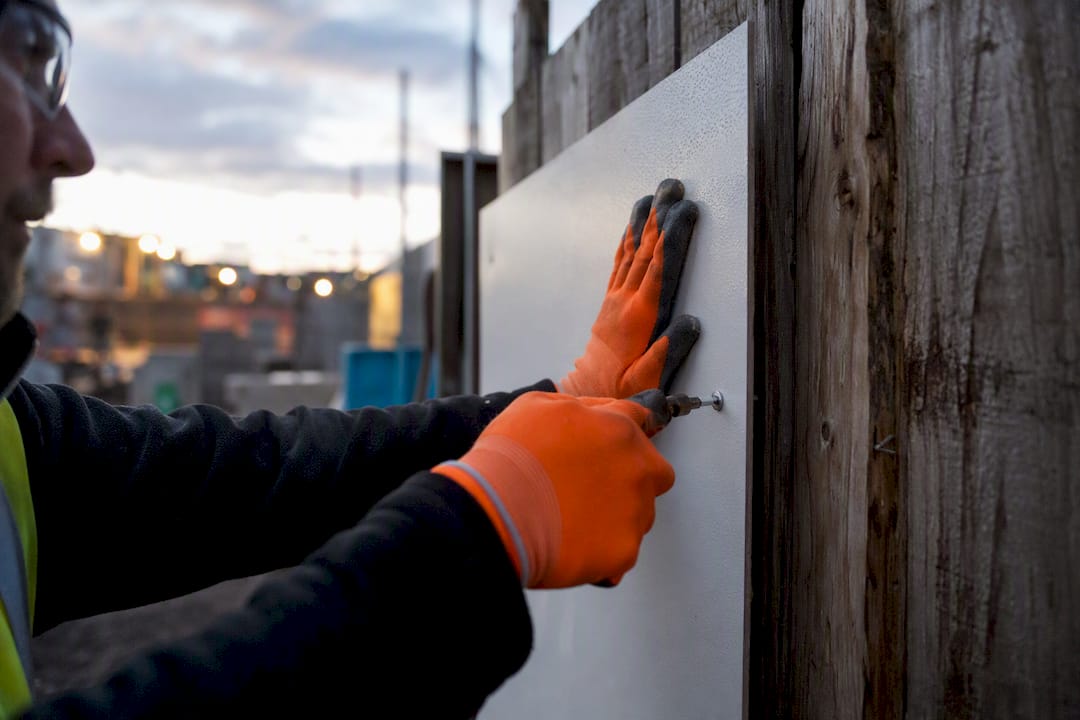
Pro Tip: *Ask your supplier for a digital proof scaled to the actual viewing distance, not a small preview on a laptop screen.
Standard kits vs bespoke boards: which do you need?
Most routine sites are well served by a standard multi-message kit. These come pre-designed with the common prohibition, mandatory and warning symbols already laid out, and they’re fast to order and inexpensive, which suits smaller contractors or short programmes where a fully custom layout isn’t worth the lead time.
Bespoke boards earn their higher cost when a site has unusual hazards, multiple phased stages, or when branding needs to appear alongside compliance information, something increasingly common on developer-led schemes where the hoarding also does marketing work.
A few procurement points worth settling before you commit:
- Send vector artwork for logos rather than low-resolution images, or expect a proofing delay while it gets recreated.
- Ask for a sample panel if you’re ordering across multiple sites, so colour and finish stay consistent between locations.
- Order a spare panel or two, particularly for information that changes often, like the named first aider or emergency contact.
- Consider modular insert systems if contact details or phase information shift regularly, so you’re not reprinting the whole board each time.
Supplier checklist: questions to ask before you order
A good supplier answers these without hesitation. A weak one gets vague fast.
- Do you design to ISO 7010 symbol standards, and can you show a sample? If they can’t answer this directly, move on.
- What materials do you recommend for a project of my length, and why? The answer should reference exposure and durability, not just price.
- Can I see a digital proof sized to my actual viewing distance? This catches legibility failures before they’re printed and shipped.
- What’s your turnaround for updates? Contact numbers and named personnel change; a board that takes three weeks to amend isn’t fit for a live site.
- Do you offer sample panels before a full order? Especially relevant for multi-site or repeat procurement.
Red flags are just as telling: a supplier who can’t name a standard they work to, has no samples to show, or quotes an unrealistically short lead time on a bespoke design, is worth questioning before you commit budget.
Pro Tip: Request a small trial order, one board, properly proofed, before committing to a batch across five or ten sites. It costs little and catches problems a screen proof never will.
How in-house manufacturing simplifies compliance and reordering
Working with a UK manufacturer that prints in-house, rather than outsourcing production, cuts the number of steps between your proof approval and a board arriving on site. A3m produces large-format signage using in-house facilities, which means fewer handoffs and faster turnaround when a contact number changes or a board needs replacing after storm damage.
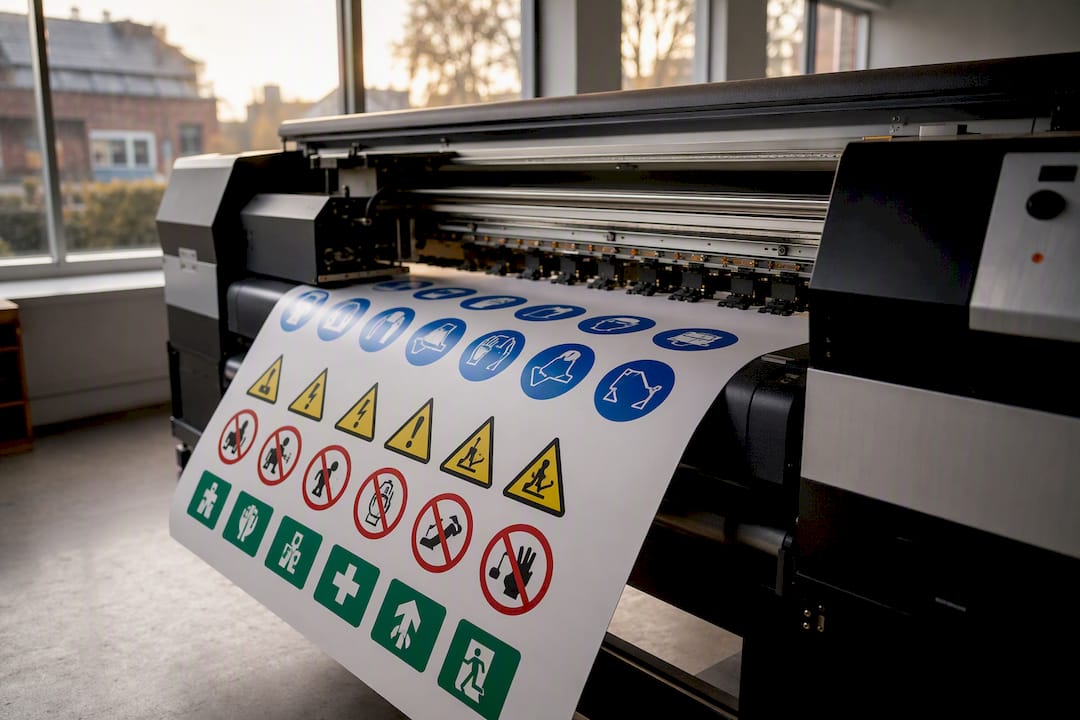
For businesses running multiple sites, a web-to-print portal keeps layouts consistent across locations while still allowing local details, like site address or named first aider, to update independently. Durable, sustainable material options also reduce how often boards need replacing over a project’s life, which matters more on longer builds than the upfront unit price does.
Why compliance guides miss the maintenance problem
Most advice on this topic stops at the point of purchase. Get the right symbols, get the right size, get it installed, job done.
HSE’s own guidance is explicit that signs must be kept in good condition and understood by the workforce, yet almost nobody budgets time or money for checking a board after it’s gone up. A board that was perfectly compliant on installation day, with the wrong first aider’s name still listed four months later, is not a minor administrative slip. It’s a live compliance gap.
My honest view: spend less energy agonising over which shade of aluminium composite to choose, and more on deciding, in writing, who checks the board monthly and who owns the update process when contact details change. The correct pictograms matter, but an outdated board with perfect symbols still fails the workforce it’s meant to protect.
Get a sample, quote and proof for your site safety board
A3m is the practical alternative to juggling a generic sign catalogue and a separate print supplier for anything bespoke. Because production happens in-house, from proofing through to the finished panel, you get one point of contact, consistent finishes across every site in your portfolio, and a much faster turn on urgent changes, like a new emergency contact or a revised assembly point, without waiting weeks for a reprint.

Every board is produced with correct ISO 7010 symbol placement and can include the CDM-relevant details your notifiable project needs, from principal contractor information to the F10 reference. Material options range from short-term boards for a few weeks on site through to weather-resistant panels built for multi-year programmes, so you’re not overpaying for durability you don’t need or underspending on a board that won’t survive the winter.
Get in touch through A3m’s signage services page to request a sample panel or a quote, and ask for a proof scaled to your actual entrance viewing distance before anything goes to print.
Primary guidance to consult
Bookmark the 1996 Regulations and HSE’s safety signs guidance for the legal baseline, and the L64 booklet for practical sizing and placement detail. Supplier guides like The Safety Sheep Store’s content checklist are useful for layout, but always check them against HSE’s own position first.
Sources
- The Health and Safety (Safety Signs and Signals) Regulations 1996
- Safety signs – HSE
- Site Safety Boards UK: What to Include – The Safety Sheep Store