

Digital short runs are the right call for most product launches and market tests, usually involving relatively low quantities, with offset printing becoming more cost-effective only at much larger volumes. It’s the difference between paying for a costly plate setup and simply printing what you need.
Before you brief anyone, three numbers matter:
- Typical MOQ band: 25 to 2,000 units, depending on whether you use a template configurator or a custom-dieline supplier
- Typical lead time: 5 to 15 working days after artwork approval, longer with specialist finishes
- Dieline choice: templates for speed and low cost, custom dielines when your product shape or brand needs it
Pro Tip: Ask any supplier for a costed crossover calculation, digital against offset, at your exact quantity. A proper quote shows you the per-unit price at both methods so you’re not guessing where the breakeven sits.
Key Takeaways
Digital printing is the most viable route for the vast majority of short packaging runs because it removes plate costs entirely and unlocks low MOQs and fast turnaround.
| Point | Details |
|---|---|
| Digital wins under crossover | Digital suits most runs below roughly 1,500–3,000 sheets; offset only pays off beyond that. |
| Match format to channel | Choose mailer boxes for ecommerce, cartons for retail shelf, sleeves for limited editions. |
| Finishes extend lead time | Foiling and embossing need tooling made, adding days even on digital runs. |
| Request the full RFQ set | Ask every supplier for MOQ, setup fees, per-unit price, lead time, and sample costs. |
| A3m offers in-house short runs | A3m provides in-house digital print, die-cutting, and finishing with proofed crossover quotes. |
Table of Contents
- What short-run packaging options are available?
- How are short runs actually produced?
- Why do brands choose short runs for launches?
- How do you choose a short-run packaging supplier?
- What are the common pitfalls in short-run packaging?
- Which sustainable options work for short runs?
- When should you choose a short run over a long run?
- How A3m supports short-run packaging projects
- Frequently asked questions
- Sources
What short-run packaging options are available?
Matching the format to the product matters more than chasing the lowest unit price. Get the format wrong and you’ll pay for it in returns, damaged stock, or a redesign three weeks before launch.
Folding cartons suit retail shelf presence and subscription boxes needing structural rigidity. Mailer boxes work well for ecommerce, since they’re built to survive transit without an outer shipper. Sleeves wrap around an existing container cheaply, ideal for limited editions or seasonal variants where you don’t want to retool the whole pack. Pouches handle food, cosmetics, and anything needing a barrier against moisture or air. Labels are the fastest and cheapest way to test multiple SKU variants without touching the substrate underneath. Rigid boxes suit premium gifting or launch kits where perceived value matters more than cost. Inserts protect fragile items and can double as a branding touchpoint. POS and CDU pieces support in-store activation rather than the product itself.
Channel and physical constraints narrow the list fast. Ecommerce favours mailer boxes and pouches that survive courier handling. Retail shelf space rewards structural cartons with strong shelf presence. Fragile items need rigid inserts or moulded trays regardless of budget. Products needing a moisture or oxygen barrier are locked into pouches or laminated stock.

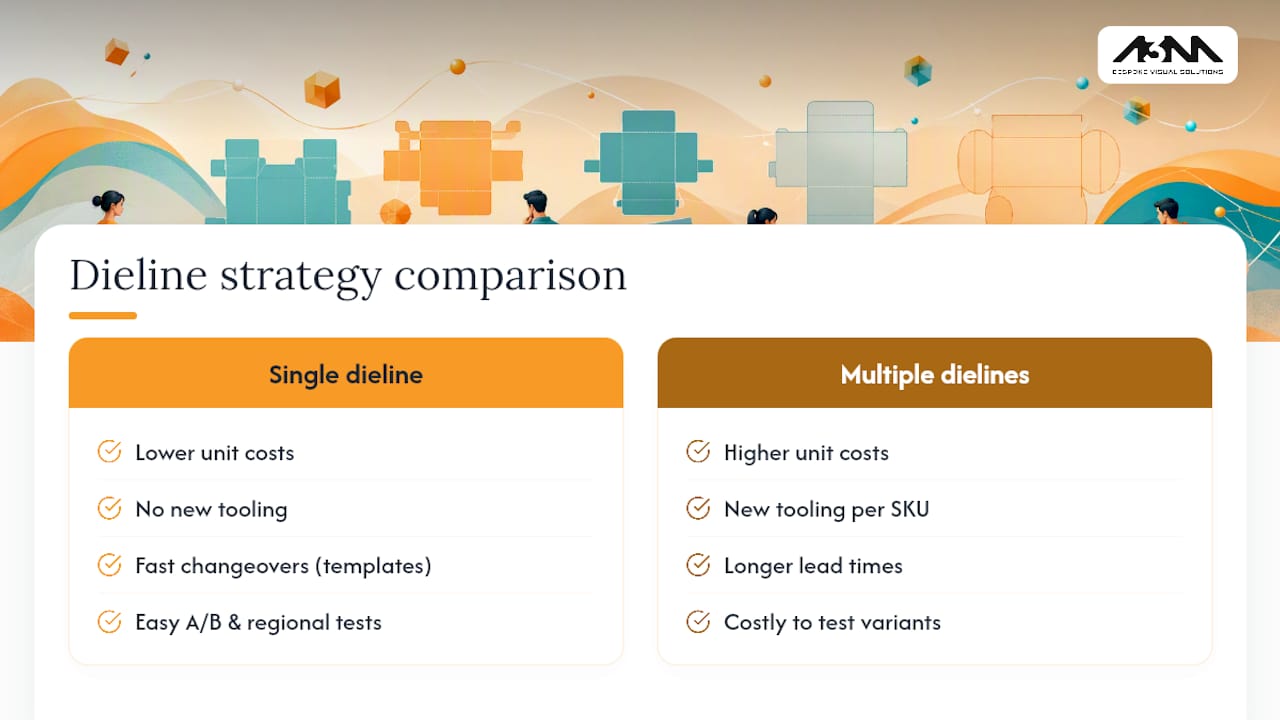
To keep unit costs down on short runs, stick to a single dieline family across SKU variants and use template configurators where your product fits a standard size. This is exactly how brands run A/B test variants, regionalised packs, or limited-edition drops without commissioning new tooling each time.
How are short runs actually produced?
Short-run packaging is produced almost entirely on digital printing presses rather than traditional offset litho, because digital carries no plate cost. That single fact is what makes runs of a few hundred units financially viable at all, and it’s what lets you print five design variants in one job rather than committing to one design across the whole batch.
Offset still earns its place for very large runs, exacting colour matching (Pantone spot colours in particular), or specialist substrates that digital presses can’t handle. The crossover point where offset becomes cheaper per unit generally sits between 1,500 and 3,000 sheets for a standard four-colour folding carton, shifting depending on substrate and how many SKU variants you’re running.
Cutting and finishing add their own trade-offs:
- Digital die-cutting handles most short-run shapes without a physical die, keeping setup cost near zero
- Laser or flatbed cutting suits prototypes and very small batches where precision matters more than speed
- Lamination (matt or gloss) protects print and adds a premium feel, with minimal impact on lead time
- Foiling and embossing deliver a standout finish but usually need a physical tool made, which adds days and cost even on a digital run
Pro Tip: Request a digital and an offset quote side by side, with per-unit and total cost broken out separately. Seeing both numbers next to each other tells you exactly where your run size sits relative to the crossover point.
Why do brands choose short runs for launches?
Short runs remove the biggest risk in a product launch: committing tooling budget to a design nobody has bought yet.
- No large upfront tooling spend, so a failed test costs hundreds of pounds rather than thousands
- Faster time to market because you skip plate-making and long offset queues
- Room to test multiple design or copy variants side by side before committing to one
- Personalisation and limited editions become viable marketing tools rather than a manufacturing headache
- Lower inventory carrying costs and the flexibility to adjust packaging by season or region
How do you choose a short-run packaging supplier?
Before requesting quotes, get four things nailed down internally:
- Finalise the SKU count per variant, not just the total unit volume
- Set a target lead date and work backwards from it, including proofing time
- Decide which finishes are must-haves versus nice-to-haves
- Agree your sustainability requirements before you start comparing quotes, not after
Once you’re briefing suppliers, a proper vendor evaluation covers MOQ, tooling and setup fees, per-unit price at your actual quantity, lead time after artwork sign-off, sample or proof costs, and shipping assumptions. Ask for all of these in writing, not verbally on a sales call.
MOQs and lead times vary enormously by supplier type:
Configurator MOQs sit at the low end because you’re using a template dieline; custom RFQ suppliers need a slightly larger run to cover setup labour.
Ask suppliers directly about quality control checkpoints, whether they store your die for re-orders, minimum re-order quantities, and what a rush order actually costs versus standard turnaround. For domestic versus overseas sourcing, landed cost matters more than unit price at small quantities, since freight and duty can wipe out an apparent saving once you’re under roughly 2,000 units.
Briefing an in-house production partner differs from briefing an external supplier. With an in-house partner, you can usually get a trial order run and physically checked before committing to the full batch, and acceptance criteria get agreed face to face rather than over email chains. External suppliers need everything specified in writing upfront, because there’s no opportunity to catch a misunderstanding halfway through production.
What are the common pitfalls in short-run packaging?
Most short-run problems trace back to one thing: nobody checked the physical proof against the digital file before the full run went to press. Colour on screen and colour on stock rarely match exactly, especially on kraft or recycled substrates.
The second common mistake is treating finishes as an afterthought. Foiling and embossing dies need lead time to manufacture, and adding them after a quote’s been agreed usually blows the schedule. Ask about finish tooling time before you fall in love with a design that needs it.
Which sustainable options work for short runs?
FSC-certified SBS board, recycled kraft, and PCR content are all workable on short runs without the cost penalty you’d expect on larger orders, since you’re not committing to a single substrate across a huge batch. Compostable stock works for some formats but check compatibility with your product before you commit.
Short runs actually support sustainable practice by design: smaller batches mean less overproduction risk, and printing regionally cuts freight distance. The trade-off is that some coatings and multi-layer laminates limit recyclability, so ask suppliers for a material spec sheet and end-of-life guidance before signing off.
Industry-wide, the Ellen MacArthur Foundation’s Global Commitment tracks how signatory brands are shifting toward reusable, recyclable, or compostable packaging, giving useful context for what a credible sustainability claim looks like versus marketing spin.
Quick wins: stick to stock dielines, avoid complex multi-layer coatings, and request written material specs rather than taking a supplier’s word for it.
When should you choose a short run over a long run?
Short runs win whenever you’re proofing a concept, testing a market, or running a limited edition, anywhere volume is uncertain or likely to change within months. Long runs earn their lower unit cost once you’ve got stable demand, fixed colours, and no plans to redesign soon.
A rough rule: if your SKU count, artwork, or volume might shift within the next two quarters, brief a short run first. The most common mistake I see is brands locking into offset tooling before they’ve actually validated demand, which turns a cheap-looking unit price into an expensive mistake.
How A3m supports short-run packaging projects
A3m runs digital printing, digital die-cutting, and specialist finishing including foiling and embossing in-house, which means your short run doesn’t get queued behind someone else’s job at a third-party finisher.

When you brief a short-run job to A3m, expect to be asked for quantities per SKU, your target delivery date, which finishes you actually need versus which ones are optional, and what level of proofing you want before the full run goes to press. That last point matters more than most brands expect: a physical sample or proof, alongside a costed comparison between digital and offset production at your specific quantity, means you’re never guessing which method actually suits your numbers. If you’re weighing up a limited edition, a regional variant, or a straightforward market test, get in touch about your short-run project and ask for a sample and a crossover quote before you commit to a run size.
Frequently asked questions
What is the minimum order quantity for short-run packaging?
It depends on the supplier type. Configurator platforms often accept 25 to 100 units, while custom RFQ suppliers typically require 250 to 2,000 units, and traditional offset usually starts above 1,000 sheets.
How long does short-run packaging take to produce?
Digital short runs typically take 5 to 15 working days after artwork approval, with specialist finishes like foiling adding extra time for tool manufacture.
Is digital printing good enough quality for packaging?
Yes, for the vast majority of short-run applications digital printing matches offset on visual quality, though offset still edges ahead on exact Pantone spot-colour matching at scale.
When does offset printing become cheaper than digital for packaging?
The crossover typically falls between 1,500 and 3,000 sheets for a standard four-colour folding carton, shifting with substrate choice and how many SKU variants you’re running.
Can I get sustainable materials on a short packaging run?
Yes. FSC-certified board, recycled kraft, and PCR content are all workable on short runs, though some compostable stocks have compatibility limits worth checking with your supplier first.
Sources
- Digital Printing vs Offset Printing for Custom Packaging | DST-Pack
- Custom Packaging Vendor Guide: How to Compare Suppliers & Avoid Costly Mistakes
- Best Small-MOQ Custom Packaging Suppliers USA (2026): 8 Vendors Rated on the 7 Metrics That Predict First-Order Success | PackOasis Blog
- Global Commitment 2022 overview | Ellen MacArthur Foundation