

Most print jobs land somewhere between same-day dispatch and three weeks, and the gap between those two extremes almost always comes down to one thing: what you’re actually asking a printer to make, and how ready your files are when you send them.
A quoted turnaround is production time after you approve your proof, not the whole journey from enquiry to unboxing. Add delivery on top of that, plus a sensible buffer, and you’ve got your real in-hand date.
- Business cards or A5 flyers, ready-to-print files: 24 to 48 hours production, then 1 to 3 days for delivery
- A2 large-format banner, standard finishing: 3 to 5 working days production, plus courier transit
- 1,000-unit litho brochure run: around 6 working days production before it even leaves the building
Pro Tip: Work backwards from your event date, not forwards from today. Nail down when you need the goods in hand, then subtract shipping, production, and proofing to find your artwork deadline.
Key Takeaways
Reliable print turnaround planning means separating production time, proofing time, and delivery time, then working backwards from your in-hand date with a buffer built in.
| Point | Details |
|---|---|
| Turnaround starts after approval | Production time is quoted from proof sign-off, not from when you first send files. |
| Ranges vary by job type | Digital runs can finish same day; exhibition builds typically need 2 to 3 weeks. |
| Proof type changes the schedule | PDF proofs take same day to 3 working days; printed proofs take 3 to 6 working days. |
| Delays are mostly avoidable | Incomplete artwork, late sign-off, and busy seasons cause most missed deadlines. |
| A3M offers in-house coordination | Large-format panels typically run 3 to 5 working days; exhibition elements need 2 to 3 weeks, all managed under one roof. |
Table of Contents
- What’s the difference between print turnaround and delivery times?
- How long does printing take for different job types?
- When does production actually start on a print order?
- What actually slows print jobs down?
- How fast can express printing and courier delivery actually be?
- How do I plan a print order backwards from my deadline?
- What lead times can you expect from an in-house production house?
- Need a production slot that won’t slip?
- Frequently asked questions
- Sources
What’s the difference between print turnaround and delivery times?
These two terms get used interchangeably far too often, and it causes more missed deadlines than almost anything else in this industry.
Production turnaround covers everything that happens inside the print facility: prepress checks, plate or digital setup, press time, finishing (lamination, foiling, binding), and packing ready for collection. Delivery, or transit, is the separate clock that starts once a courier or postal service takes the parcel and ends when it reaches you.
The clock on production almost always starts after you’ve signed off your proof, not when you first sent your files. A printer might quote “3 working days” and mean production only, so it’s worth asking directly whether that figure includes shipping or not.
- Production turnaround: file approval → prepress → press → finishing → packing
- Delivery: courier collection → transit → in-hand
Pro Tip: Always ask a supplier for their daily cut-off time. Miss it by ten minutes and your “same-day” job quietly becomes tomorrow’s job.
How long does printing take for different job types?
Every category of print has its own rhythm, and mixing them up when you’re planning a campaign is one of the fastest ways to blow a deadline.
Digital short runs are the quickest of the lot. If your files are press-ready, runs of 50 to 500 copies frequently complete within the same working day, because there’s no plate-making or extensive makeready involved. Litho printing needs more lead time: press setup, ink drying, and larger-format handling routinely add half a working day or more before you even reach finishing.
Booklets and multi-page products sit in a wider band depending on print method. Mixam’s own production figures put a 100-booklet digital run at around 4 working days, and a 1,000-booklet litho run at roughly 6 working days, with drying, folding, cutting, and binding all baked into that window. Packaging tends to run similarly, since die-cutting and creasing add extra handling steps that a flat sheet doesn’t need.
Large-format banners and vinyl typically need 3 to 5 working days depending on size and lamination. Exhibition builds and branded environments run longer again, often two to three weeks, because they involve structural fabrication alongside the print. Apparel and screen printing carry their own lead time for garment sourcing before a single stitch of ink goes down.
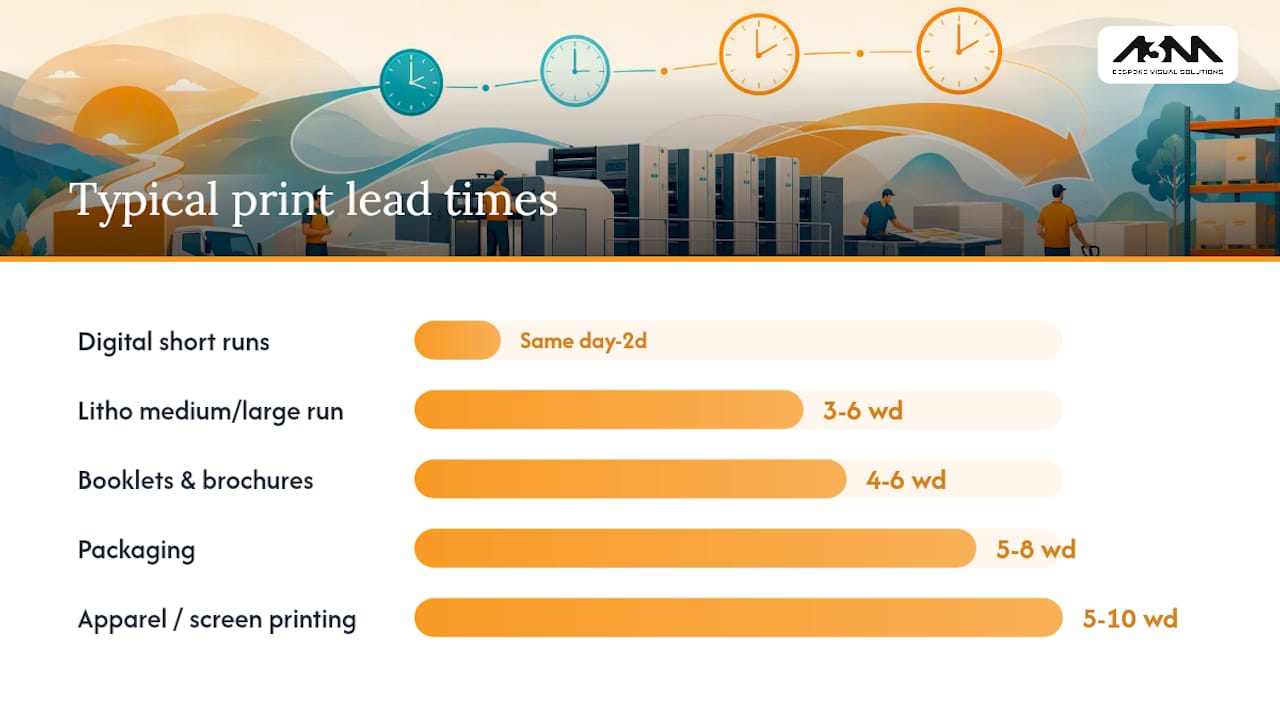
| Print type | Typical production window |
|---|---|
| Digital short run (business cards, flyers) | Same day to 2 working days |
| Litho medium/large run | 3 to 6 working days |
| Booklets and brochures | 4 to 6 working days |
| Large-format banners and vinyl | 3 to 5 working days |
| Packaging | 5 to 8 working days |
| Exhibition stand builds | 2 to 3 weeks |
| Apparel/screen printing | 5 to 10 working days |
| Direct mail | 3 to 5 working days (clean data) |
A striking best-case example: 30,000 A5 postcards can be printed and handed to a postal carrier within a single working day if the data and artwork are confirmed by the morning cut-off. That’s the ceiling of what’s achievable, not the average.
When does production actually start on a print order?
Production doesn’t begin the moment you place an order. It begins once you’ve approved a proof, and the type of proof you choose changes how long that step takes.
A PDF proof is quick: most suppliers turn these around the same day or within 3 working days. A printed proof (a physical wet proof, useful for checking colour or a special substrate) takes longer, typically 4 to 6 working days once you factor in the printer producing it, shipping it to you, and shipping your signed-off copy back.
- PDF proof: same day to 3 working days
- Printed proof: 3 to 6 working days depending on the product
The wider industry norm is that full production begins only after sign-off, meaning a slow approval doesn’t just delay the proofing stage. It pushes your entire production window back by the same number of days, no matter how fast the press itself runs.
What actually slows print jobs down?
Most delays aren’t the printer’s fault, and they’re rarely random. They tend to cluster around a handful of predictable causes: incomplete artwork, file formats that need correcting, a late switch in quantity that tips a job from digital to litho, special finishes that need extra drying or curing time, and approvals that drag on because three people in your business each want a different tweak.
Seasonal pressure matters too. Holiday periods and January backlogs are consistently cited as the busiest, slowest windows across the industry, so a job that would normally take four days can stretch closer to seven simply because everyone else booked their Christmas print at the same time you did.
- Send print-ready files the first time; a proper preflight check catches most issues before they reach the press
- Nominate one approver so sign-off doesn’t bounce between three inboxes
- Confirm the supplier’s cut-off time before you assume a same-day slot is available
Pro Tip: If you’re planning for a fixed event date, tell your printer that date up front. Most will reserve a production slot rather than queue you behind standard work.
How fast can express printing and courier delivery actually be?
“Express” print doesn’t automatically mean the parcel lands on your desk tomorrow morning, and conflating the two is where a lot of last-minute orders go wrong.
Same-day print and collection is genuinely achievable if your files are approved before the supplier’s morning cut-off, usually around 10am. Next-day production paired with an express courier is the more common route for urgent jobs that still need to travel. Standard postal delivery typically runs 2 to 5 working days, while 1st Class Advertising Mail delivers within 2 to 3 working days of handover. Express couriers usually manage 24 to 48 hours, though rural and Highland addresses often need an extra day, and peak seasons slow every carrier down.
Express production and express delivery are two separate promises. Confirm both, not just one, before you tell a client the job will be there Thursday.
How do I plan a print order backwards from my deadline?
Work from your in-hand date, not from today’s date, and the whole schedule falls into place logically.
- Fix your in-hand date first, the day you genuinely need the goods on site.
- Subtract your delivery window (standard post, express courier, or self-collection).
- Subtract production time for your specific job type, using the ranges above as a guide.
- Subtract proofing and approval time, allowing for at least one revision round.
- Add a buffer of 1 to 2 working days for anything unexpected, then that’s your artwork deadline.
Confirm cut-off times, proof type, and courier options with your supplier before you commit to a date. For a corporate event landing on a Friday, that often means final artwork approved by the previous Monday.
What lead times can you expect from an in-house production house?
Working with a supplier that manufactures on its own premises changes the maths, because there’s no handover between a design studio, a separate print shop, and a separate fabricator each adding their own queue time.
At A3M, a typical large-format panel run for retail or hospitality graphics runs 3 to 5 working days once artwork is approved. Individual exhibition stand elements generally need 2 to 3 weeks to allow for structural build alongside the print. Multi-site rollouts, where the same graphics need producing and shipping to several locations, typically run on a rolling schedule agreed at order stage rather than a single fixed date.
- Large-format panels: 3 to 5 working days after approval
- Exhibition stand elements: 2 to 3 weeks
- Multi-site rollouts: scheduled individually, coordinated centrally
Every timeline here is an estimate built from typical working patterns, not a guarantee. Busy periods, complex finishes, and late approvals can all extend them, so confirm your specific dates when you place the order.
A production team’s view on staying on schedule
One habit does more to protect a deadline than anything else: get every stakeholder’s comments onto a single annotated PDF before it comes back to us. Three separate emails with three different opinions is how a two-day job becomes a five-day job. Flag a fixed deadline early, and tell us the moment something changes. Early notice beats a panicked phone call every time.
Need a production slot that won’t slip?
If your deadline is tight or your project is genuinely bespoke, a general commercial printer working through a queue of unrelated jobs isn’t always built for that. A3M manufactures large-format graphics, exhibition stands, and signage in-house, which means one team owns your schedule from artwork approval through to installation, rather than three separate suppliers each adding their own buffer.

That matters most for planners juggling event dates, multi-site rollouts, or installations that need coordinating on-site rather than just posted out. A planner working towards a launch date might look at large-format manufacturing for retail graphics, bespoke exhibition stands for a conference appearance, or signage that needs installing across several sites in the same week. If you’re sourcing plotters or print hardware for in-house capacity of your own, Global Office Machines stocks equipment worth comparing against outsourced production costs.
Get in touch with A3M to check availability and reserve a production slot for your project.
Frequently asked questions
How long does printing take on average?
Most standard jobs, like flyers or business cards with print-ready files, take 24 to 48 hours in production. Larger or more complex jobs, such as litho brochure runs or exhibition builds, can take one to three weeks.
Does print turnaround time include delivery?
Usually not. Quoted turnaround typically covers production only, from proof approval to the parcel leaving the building. Delivery is a separate window on top, whether that’s 24 hours by express courier or several days by standard post.
What’s the fastest way to get a print job turned around quickly?
Send fully print-ready, preflighted files, approve your proof the same day it arrives, and confirm your supplier’s cut-off time so you land in that day’s production run rather than the next one.
Why do print quotes only give estimates, not guaranteed dates?
Because so many variables sit outside a printer’s full control, including courier performance, seasonal demand spikes, and how quickly a client approves a proof. Confirming your exact dates at order stage is the only way to firm up an estimate into a commitment.
Sources
- How Long Does Direct Mail Take? | Mailings Direct
- Production Time vs Shipping Time in Printing Explained – The Print Reviewer
- Print production timeline | Mixam