

Most standard shop fascia signs have “deemed consent” and need no application at all, provided they stay under key size and height limits. You will need express advertisement consent if your sign is illuminated (any size), is larger than a small size limit on business premises, is mounted at a height above a certain threshold, or takes the form of a hoarding. Local planning authorities decide these applications purely on amenity and public safety, usually within eight weeks.
TL;DR:
- Signs larger than 0.3 sqm, illuminated, mounted above 4.6 meters, or used as hoardings require express consent, which typically takes eight weeks to process.
- Deemed consent generally applies to small, unilluminated fascia signs under size and height limits and can be revoked in special designated areas.
- Applications for permitted signs need detailed plans, illumination specs, structural details, landowner permission, and must be submitted through the Planning Portal.
- Local planning authorities focus solely on amenity and public safety, and ignoring rules or failing to consult landlords often leads to enforcement or refusal.
- Proper pre-application advice and working with experienced signage manufacturers can help ensure compliance and reduce delays in obtaining consent.
Table of Contents
- What the regulations actually say about advertisements
- Deemed consent vs express consent: the thresholds that matter
- How to apply for express advertisement consent
- What planning officers actually assess: amenity and public safety
- Special cases: listed buildings, control areas, highways and hoardings
- What happens if you install signage without consent
- Your pre-installation checklist
- How a UK signage manufacturer supports a successful application
- Common mistakes I keep seeing, and how to fix them
- Getting your signage right first time with A3m
- Sources
What the regulations actually say about advertisements
The legal framework sits in the Town and Country Planning (Control of Advertisements) (England) Regulations 2007, backed by guidance on Gov and the Planning Portal. It is worth grasping early that advertisement consent is a separate regime from ordinary planning permission, with its own rules, its own application process, and its own decision tests.
The word “advertisement” covers far more than you might assume. It includes fascia signs, projecting signs, hoardings, posters, flags, price markers, illuminated displays, and even some temporary banners. If it is visible from outside your premises and conveys a message, it almost certainly falls within scope.
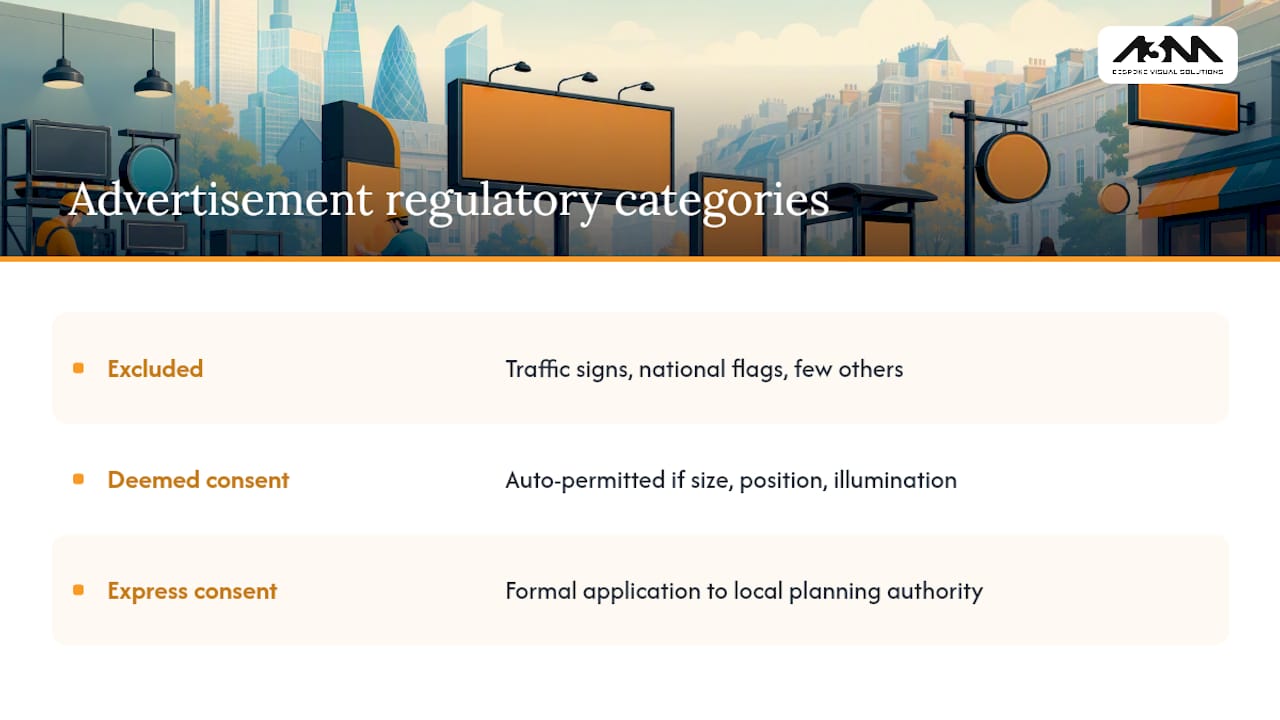
Every sign lands in one of three regulatory buckets. Some are excluded entirely from control (traffic signs, national flags on their own flagpoles, and a handful of similar categories). Many everyday business signs fall under deemed consent, meaning they are automatically permitted as long as they satisfy set conditions on size, position, and illumination. Anything outside those classes needs express consent, which means a formal application to your local planning authority (LPA).
Understanding which bucket your sign sits in is the entire game. Get it wrong, and you either waste weeks on an unnecessary application or install something that triggers enforcement action. Our guide to signage meaning breaks down how sign type and design choices interact with these categories in more detail.
Deemed consent vs express consent: the thresholds that matter
Deemed consent exists precisely so ordinary businesses do not need to apply for permission every time they replace a fascia board. But the classes that qualify come with hard numeric limits, and stepping over any one of them shifts you into express consent territory.
The figures that trip up most applicants are:
- a certain size limit for advertisements on business premises, above which express consent is required, even if unilluminated.
- illuminated signs of any size automatically losing deemed consent.
- a mounting height threshold, above which signs typically require express consent.
- Temporary signs and estate agents’ boards — these have their own deemed consent classes, but usually carry strict time limits and size caps.
A few worked examples make this concrete. A small unilluminated fascia sign naming the business, sized well under 0.3 sqm and mounted at normal shopfront height, will usually qualify for deemed consent. Swap that same sign for an illuminated version and it needs an application, even though nothing else has changed. A gable-end advert painted or fixed high on a wall almost always exceeds both the size and height thresholds together. Freestanding pavement signs sit in a grey area: many councils treat them as street furniture requiring separate highways consent rather than advertisement consent, so it pays to check locally.
Deemed consent is not guaranteed everywhere. LPAs can withdraw it entirely within Areas of Special Control, a designation often used on historic high streets and conservation frontages, which is one reason treating deemed consent as automatic can catch business owners out.
How to apply for express advertisement consent
Once you know express consent applies, the process is straightforward, provided you assemble the right paperwork before you submit. A validated application starts the statutory eight week clock; an incomplete one just sits in a queue while the LPA asks for missing information.
Your application pack should include:
- A site location plan showing the property and at least two named roads, so the LPA can identify the exact site.
- Scaled drawings and elevations of the proposed sign, with North clearly marked.
- An illumination specification, where relevant, covering brightness, colour temperature, and any dimming controls.
- The proposed duration of display, particularly important for temporary signage and hoardings.
- Structural details for anything fixed, cantilevered, or freestanding, including hoardings.
- Evidence of landowner permission, since the applicant is not always the freeholder.
Fees vary by advertisement type. Planning Portal’s indicative bands put adverts relating to a business on its own premises at around £174, with other advertisement types closer to £610, though individual councils set and update their own charges annually, so always confirm the current figure with your LPA before submitting.
Pro Tip: Book pre-application advice with your LPA’s planning department before finalising your drawings. It typically costs a small fee but often surfaces objections early, saving far more in delay and redesign costs later.
Submit through the Planning Portal rather than posting paper plans; it flags missing documents immediately rather than after a week in the LPA’s inbox. If a case officer comes back with validation queries, respond within their stated deadline. Slow replies are one of the most common reasons applications drift well past eight weeks.
What planning officers actually assess: amenity and public safety
LPAs are legally restricted to two tests when they weigh an advertisement application: amenity and public safety. Commercial benefit, brand visibility, and how much the sign might boost footfall are simply not relevant considerations, however persuasive they feel to the applicant.
Amenity covers the visual impact of the sign on its surroundings: does it clash with the building’s character, dominate the streetscape, or sit awkwardly against neighbouring properties? Public safety covers driver distraction, obstruction of sightlines or official road signs, and glare from illuminated displays, particularly near junctions.
Practical steps that measurably improve your odds of approval include:
- Reducing overall sign area, even modestly, where the design comfortably allows it.
- Specifying diffuse rather than direct illumination to cut glare.
- Lowering mounting height where structurally possible.
- Choosing materials and colours that echo the building rather than fight it.
- Adding timed dimming controls so illumination reduces automatically after dark.
Council Supplementary Planning Documents (SPDs) and local design guidance are treated as material considerations in these decisions, so it is worth reading your LPA’s published policy before you finalise a design rather than after a refusal notice arrives.
Special cases: listed buildings, control areas, highways and hoardings
A handful of situations sit outside the standard rules and catch out even experienced applicants.
- Listed buildings need Listed Building Consent in addition to advertisement consent, covering any fixing into historic fabric, not just the sign’s appearance.
- Areas of Special Control and local orders let an LPA withdraw deemed consent classes outright. Always check council policy before assuming a “standard” sign qualifies automatically.
- Highway land requires separate permission from the highway authority, particularly relevant for projecting signs over pavements or anything fixed to street furniture.
- Hoardings, whether advertising a construction site or screening a shopfront refit, normally require express consent alongside structural safety documentation confirming wind loading and fixing methods.
- Digital and animated adverts almost always need express consent, given their higher potential for driver distraction after dark.
If you are commissioning site hoardings for a development or refit, our guide to property development site signage covers the construction hoarding regulations that typically apply alongside advertisement consent.
What happens if you install signage without consent
Displaying an advertisement without the required consent is a breach of planning control, and LPAs have real enforcement powers to act on it. The most common outcome is a discontinuance notice, requiring removal within a set period, but persistent non-compliance can escalate to prosecution and fines, including continuing daily fines for each day the breach continues after a notice expires.
Every advertisement, deemed or express, is also subject to standard conditions: it must be kept in a clean and tidy condition, maintained in a safe state, displayed only with the consent of the site owner, and positioned so it does not obscure any official traffic sign. Breaching these conditions can trigger enforcement even where the original consent was valid.
If your application is refused, you have a right of appeal to the Secretary of State, and many refusals turn out to be resolvable through amendment rather than a lengthy appeal process. Common grounds for a successful appeal or resubmission include reducing sign area, softening illumination, or repositioning to remove a safety objection the original design raised. In practice, negotiating directly with the case officer over a revised design is usually faster than a formal appeal, which can take several months to resolve.
Your pre-installation checklist
Before you order any sign, work through this sequence:
- Measure the proposed sign area and mounting height against the 0.3 sqm and 4.6 m thresholds.
- Confirm whether the building is listed or sits in a conservation area.
- Check whether the site falls within an Area of Special Control by contacting the LPA or reviewing its published policy.
- Secure landlord or site owner permission in writing, since this is a standard condition on every advertisement.
- Decide on illumination and structural requirements early, as both affect which documents your application needs.
- Get production quotes that include LPA-ready drawings, not just visuals for your own approval.
- Use pre-application advice for anything ambiguous, and bring in a planning consultant for listed buildings, hoardings, or contested sites.
Landlord permission issues come up often enough that it is worth checking your lease terms alongside planning rules; Landlord Compliance covers the licensing side of this where site-owner consent and planning consent overlap. For a fuller breakdown of how local authority rules can diverge from the national deemed consent framework, see our guide on local authority signage permission.
How a UK signage manufacturer supports a successful application
A manufacturer that understands advertisement consent can shape your submission long before it reaches the LPA. That means producing scaled elevations with North correctly marked, illumination spec sheets covering brightness and dimming, structural fixing details, and safety test certificates for anything wall-mounted or projecting.
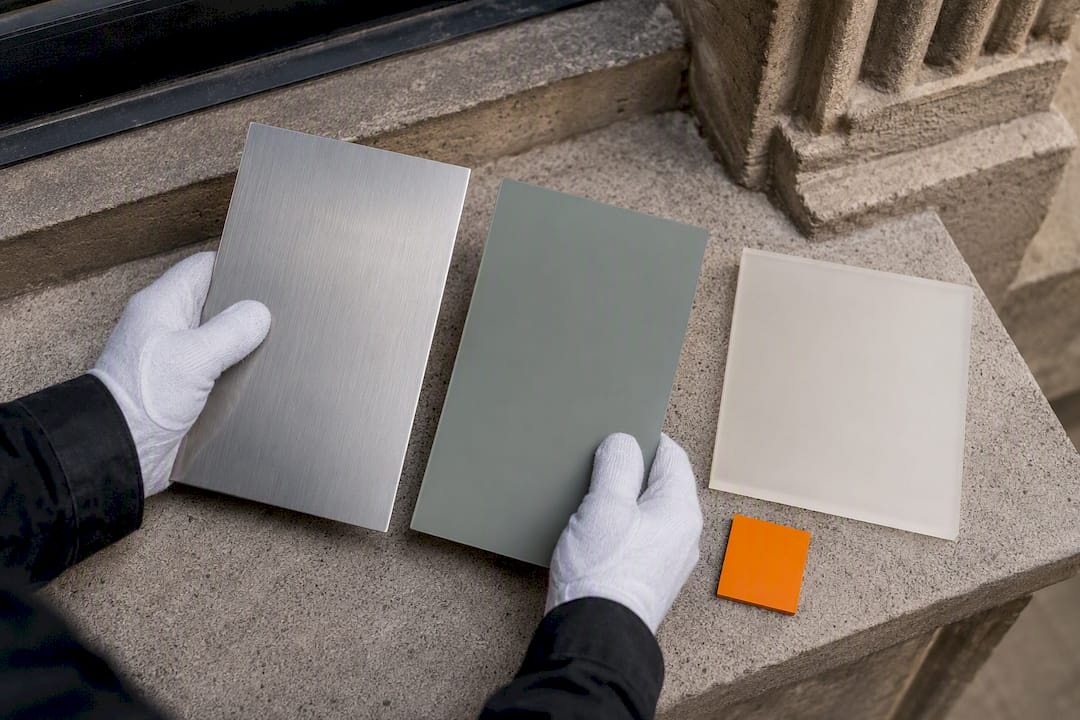
Handling design, manufacture, and installation through one supplier removes a common failure point: mismatched responsibility for fixings and electrical safety between the people who designed the sign and the people who bolted it up. Material choice matters too. Sympathetic finishes and muted colour palettes on heritage frontages genuinely help amenity assessments, where a stark plastic fascia might not.
Pro Tip: Ask any prospective signage supplier to show you a previous LPA submission pack, not just a design mock-up. The quality of that paperwork tells you far more about their planning experience than their portfolio does.
Common mistakes I keep seeing, and how to fix them
The biggest error is treating deemed consent as permanent rather than conditional. It only holds while your sign meets the size, height, and illumination rules, and LPAs can withdraw it locally without much warning in sensitive areas.
The second is skipping landlord permission because it feels like a formality. It is a standard condition on every advertisement, and enforcement teams do check.
The third is under-specifying illumination controls, then discovering after installation that a dimming schedule or brightness limit was actually required to satisfy the public safety test. None of these mistakes are complicated to avoid. They just need checking before the sign is ordered, not after it is refused. Where a design sits close to any threshold, pre-application advice is worth the modest fee, and where a building is listed or a site sits within an Area of Special Control, involving a specialist supplier early saves far more time than it costs.
— Steve
Getting your signage right first time with A3m
A3m is the practical alternative to juggling a designer, a planning consultant, and a separate fabricator for every sign project. We prepare scaled elevations, illumination specifications, and structural fixing details as part of the design process, not as an afterthought once the LPA asks for them, which means your application pack is ready to submit rather than pieced together under deadline pressure.

Because manufacturing happens in-house, the drawings we submit to your LPA match exactly what gets built and installed, with one point of contact for quality and safety rather than three. We also work with sustainable materials and finishes that tend to sit more comfortably with amenity assessments on heritage or conservation frontages. If you are planning a new fascia, a projecting sign, or hoardings for a site refit, visit our signage services page to request a quote or ask about a pre-application drawing pack before you commit to a design.
Sources
- Advertisement consent – Consent types – Planning Portal
- Gov
- The Town and Country Planning (Control of Advertisements) (England) Regulations 2007
- Outdoor advertisements and signs: a guide for advertisers