

Six board families cover almost every packaging brief you’ll receive: solid bleached sulfate (SBS), folding boxboard (FBB), coated recycled board (CRB) or white-lined chipboard (WLC), coated unbleached kraft (CUK), greyboard/chipboard, and corrugated. Each one solves a different problem, and choosing the wrong family is the single most common cause of packaging rework we observe.
Paperboard itself is defined by caliper and multi-ply construction, which is what separates it from ordinary printing paper and from corrugated board’s fluted core. Here’s the shortlist by application:
- Cosmetics and premium retail — SBS, for the whitest base and cleanest foil/emboss results
- Everyday folding cartons (cereal, FMCG) — FBB, for the best stiffness-to-weight ratio
- Recycled-content claims — CRB/WLC, where sustainability messaging outweighs top-end print fidelity
- Craft, food-service or rustic branding — CUK/natural kraft, valued for its unbleached, fibrous look
- Rigid boxes and inner supports — greyboard/chipboard, chosen purely for bulk and structural stiffness
- Transit and e-commerce shipping — corrugated, for cushioning and stacking strength
Key Takeaways
Board selection works best as a chain decision: fibre and ply determine print fidelity, print fidelity determines finish options, and finish options determine converting cost and lead time.
| Point | Details |
|---|---|
| Match grade to function | Use SBS for premium print, FBB for everyday cartons, CRB/WLC for recycled claims, greyboard for rigid cores. |
| Specify caliper, not just GSM | Caliper drives fold and stiffness performance; always request both figures with tolerance ranges. |
| Request certificates, not labels | Ask for FSC/PEFC chain-of-custody documents and stated recycled-content percentages on invoices. |
| Proof on the real substrate | Foil adhesion and colour shift between stocks, so approve proofs on the nominated board and finish. |
| Bring in a manufacturing partner early | A3M offers in-house sampling, litho-lamination, and finishing to validate specification before a full production run. |
Table of Contents
- What are the main packaging board types?
- What technical specs actually define a board grade?
- How do you choose the right packaging board?
- Which finishes suit which board type?
- How sustainable are different packaging boards?
- What are typical GSM and caliper ranges by board type?
- What converting constraints affect board choice?
- When should you bring in a packaging or print partner?
- A manufacturer’s note on getting the spec right
- How A3M supports packaging board selection and production
- Sources
What are the main packaging board types?
Every commercial paperboard grade is a variation on the same theme: layered wood fibre, pressed and dried to a specified caliper, then coated or left natural depending on what the brand needs it to do on shelf. The differences between grades come down to fibre source, bleaching, ply count, and coating weight, and those variables decide everything from foil adhesion to recyclability. Trade guidance on board grades consistently groups the commercial market into the same handful of categories, which makes cross-supplier comparison reasonably straightforward once you know what to ask for.
SBS (solid bleached sulfate)
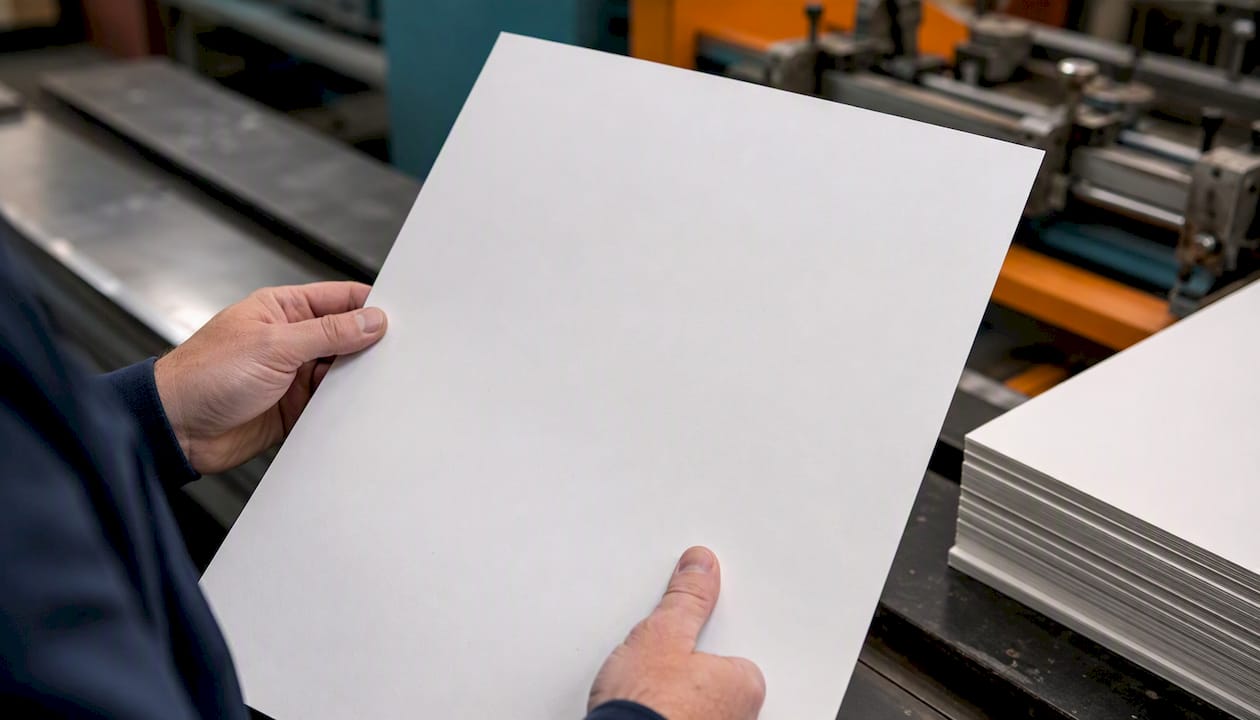
Made from bleached virgin softwood fibre, SBS gives you the brightest, most consistent print surface on the market. It takes foil, embossing, and fine screen printing better than any other grade, which is why cosmetics, pharmaceuticals, and premium spirits packaging default to it. Food-contact grades are widely available, and the surface holds tight registration on multicolour litho work.
FBB (folding boxboard)
FBB uses a bleached or unbleached chemical pulp outer layer over a mechanical pulp core, giving it excellent stiffness for its weight. It’s the workhorse of European folding carton production. Cereal boxes, confectionery, and toiletries packs run on FBB because it folds cleanly, scores well, and costs less than SBS without a dramatic drop in print quality.

CRB / WLC (coated recycled board and white-lined chipboard)
Built from recycled fibre with a clay-coated white top liner, CRB and WLC trade a small amount of print fidelity for a genuine recycled-content story. Greyer core fibre can show through on lighter coating weights, so heavier coat weights or a double-lined structure are worth specifying if brand colours need to stay flat and consistent.
CUK / SUS (coated unbleached kraft and natural kraft)
Unbleached softwood kraft fibre gives CUK its characteristic warm brown tone and high tear strength, and one side is often clay-coated for printability while the reverse stays natural. It’s become the default for artisan food packaging, takeaway, and any brand leaning into an “unprocessed” aesthetic.
Chipboard/greyboard, C1S/C2S, and CCNB
C1S and C2S refer to coating on one side or two sides of any base stock, a spec detail rather than a separate material. CCNB (clay-coated news back) is a lower-cost recycled board with a coated print face, common in low-margin retail cartons where budget outweighs finish quality.
Corrugated (flute overview)
Corrugated isn’t paperboard, it’s a fluted core sandwiched between liners, and it belongs in the conversation because so many specification briefs confuse the two. DNPackaging’s material guide draws the same line: paperboard handles print and structure in a single sheet, corrugated handles impact and compression across a transit journey.
| Board type | Best for / typical use | GSM / caliper range | Ply structure | Print surface quality | Recyclability | Relative cost |
|---|---|---|---|---|---|---|
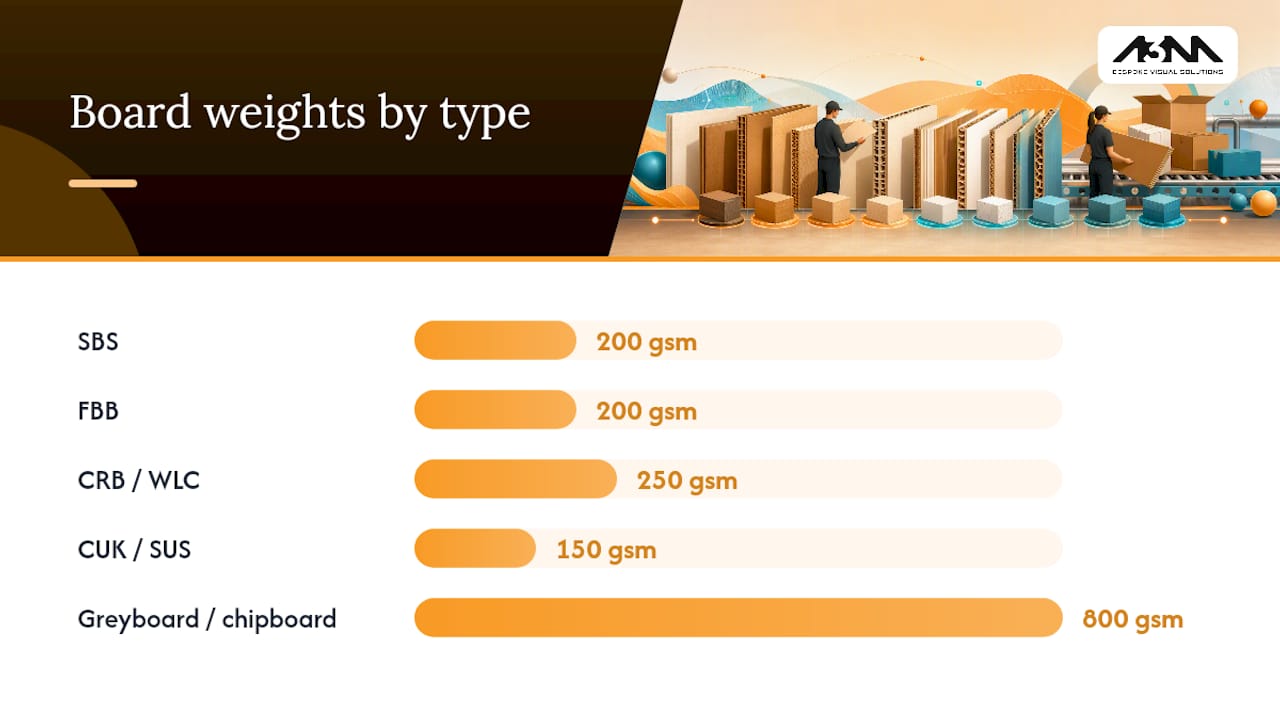
| SBS | Cosmetics, pharma, premium retail | 200gsm | Single or multi-ply, bleached virgin fibre | Excellent, best foil/emboss response | Recyclable, virgin fibre | High |
| FBB | FMCG folding cartons | 200gsm | Multi-ply, bleached outer/mechanical core | Very good | Recyclable | Medium |
| CRB/WLC | Recycled-claim packaging | 250gsm | Multi-ply recycled core, clay-coated liner | Good, some show-through risk | High recycled content | Medium/low |
| CUK/SUS | Craft, food-service, kraft branding | 150gsm | Single or duplex, unbleached kraft | Good on coated face | Recyclable, often unbleached | Medium |
| Greyboard/chipboard | Rigid boxes, inner supports | 800gsm | Multi-ply recycled, uncoated | Poor, used uncovered or laminated | High recycled content | Low |
| Corrugated (E/B/C flute) | Transit, e-commerce shipping | Varies by flute, not GSM | Fluted core between two liners | Fair, print usually on liner | Recyclable | Low/medium |
What technical specs actually define a board grade?
Grammage, expressed in grams per square metre, is the standard weight measurement, but weight alone doesn’t tell you how a board behaves on a converting line. Caliper, the physical thickness measured in points or micrometres, matters more for stiffness and fold performance because two boards at identical GSM can feel completely different depending on fibre bulk and ply count. Multi-ply construction adds rigidity without adding proportional weight, which is why FBB often outperforms a heavier single-ply board on shelf stiffness.
Stiffness, tested via Bendtsen or Taber methods, predicts how a carton resists crushing on a retail shelf. Burst and edge crush values matter more for corrugated shipping cases than for folding cartons, since they measure resistance to compression during stacking and transit. Surface gloss, opacity, and brightness govern how colour reproduces once ink hits the sheet.
- Higher GSM: greater stiffness and shelf presence, but higher material cost and more gluing pressure required
- Higher caliper at the same GSM: better fold memory, useful for hinged lids and rigid box walls
- More plies: added rigidity without proportional weight gain, though ply delamination risk increases
- Higher brightness/opacity: cleaner colour reproduction, particularly noticeable on process colour artwork
How do you choose the right packaging board?
Work through the brief before you touch a supplier quote.
- Define the product’s weight and fragility. Heavier or fragile contents need higher caliper or a corrugated outer, not just a heavier paperboard.
- Confirm the packaging’s function. Retail shelf presence calls for print fidelity; transit calls for compression resistance.
- Set the finish and print fidelity target. Foil, embossing, and fine screens point towards SBS or FBB; recycled claims point towards CRB or WLC.
- Fix sustainability requirements. Decide whether FSC chain-of-custody or a specific recycled-content percentage is contractually required before quoting.
- Set budget and run length. Short runs tolerate higher unit costs; long runs justify tooling investment in a premium grade.
- Check converting constraints. Confirm your die-cutter and folder can handle the caliper and ply structure you’re specifying.
When you brief a supplier, ask directly:
- What’s the minimum order quantity at this caliper and GSM?
- Which coatings and laminations are compatible with this base stock?
- Can you supply food-contact certificates for this grade?
- What’s the typical lead time and cost band for this specification?
Watch for quotes that specify caliper without GSM (or vice versa) with no cross-reference, no stated tolerance range, or vague sustainability claims with no certificate attached. Those gaps tend to surface as disputes later in production, and board grade selection genuinely does affect press behaviour and cost right through the production chain, not just at the point of purchase.
Which finishes suit which board type?
Clay coating, aqueous varnish, UV coating, lamination, cold foil, hot foil, and soft-touch finishes all behave differently depending on the base stock. SBS accepts foil and embossing with minimal show-through and holds fine dot detail well, because its bleached surface gives even ink absorption. CRB can suffer patchy foil adhesion if the coating weight is thin, since recycled fibre underneath can telegraph through. FBB sits between the two, handling most finishes competently without SBS’s premium cost.
Press behaviour also shifts with substrate: absorption rates and dot gain differ between coated and uncoated stock, which affects how CMYK colour reproduces on the finished sheet. Litho-lamination, printing on a thin sheet then bonding it to a rigid board, is often the better route for high-fidelity jobs that need a heavier caliper than a single sheet can carry economically. Our own guide to print quality and brand perception covers how finish choice changes shelf impact in more depth.
Pro Tip: Always insist on a press proof on the actual nominated board and finish, not a bench proof on a different stock. Colour and foil adhesion can shift noticeably between substrates, and a proof on the wrong sheet will mislead your approval process.
How sustainable are different packaging boards?
Recycled-content boards like CRB and WLC generally sacrifice a degree of brightness and stiffness compared with virgin fibre grades such as SBS and FBB, but the gap has narrowed as coating technology has improved. Buyers increasingly want documentation, not just a logo. Ask for FSC or PEFC chain-of-custody certificates and a stated recycled-content percentage on the invoice itself, not just printed on the carton.
Regulatory pressure is also reshaping component choices: UK government restrictions on single-use plastics increasingly affect plastic display windows and laminates on cartons, pushing specifiers towards water-based coatings or fully paper-based window alternatives.
- FSC/PEFC certificates should specify chain-of-custody status, not just membership
- Recycled-content claims should state a percentage, not just “recycled” on the pack
- Water-based coatings and paper windows are increasingly viable substitutes for plastic components
Procurement teams are asking for that paper trail more often than they used to, and buyers increasingly expect documented recycled-content evidence rather than a simple label claim on the finished pack.
What are typical GSM and caliper ranges by board type?
Specification ranges vary by mill and market, but the figures below give a workable starting point for quoting and comparison. Supplier tolerances typically run at plus or minus a few percent on GSM and caliper, so always confirm the exact tolerance band before locking a spec.
Trade sources commonly recommend a caliper range of roughly 18 to 24pt for premium folding cartons, which lines up with mid-to-upper SBS and FBB specifications. Points and micrometres both describe the same physical thickness; converting between the two matters when comparing a UK mill’s caliper figure against a European supplier quoting in microns. Small-run orders often carry a minimum caliper or GSM step, since mills batch-produce at fixed thicknesses rather than custom-run every order.
What converting constraints affect board choice?
Die-cutting, scoring, and folding tolerances tighten as caliper increases, and high-GSM boards slow down press and finishing lines because they need more dwell time to score cleanly without cracking. Glueing and heat-setting also become less forgiving on heavier stock, since adhesive needs longer to cure across a thicker joint.
- Confirm scoring tolerances with your converter before finalising artwork on anything above 18pt
- Expect slower machine speeds on greyboard and heavy multi-ply SBS compared with standard FBB
- Special finishes like foiling or soft-touch lamination add production days, so factor that into lead time
Pro Tip: Run a short pre-production sample, even just 50 to 100 units, before committing to a full print run. It’s the cheapest way to catch a scoring or folding fault before it becomes a warehouse full of unusable cartons.
When should you bring in a packaging or print partner?
Call in a specialist supplier when a brief involves complex finishes, food-contact certification, tight structural tolerances on a rigid box, or when you need converting and fulfilment handled under one roof rather than split across vendors.
- Complex foil, emboss, or soft-touch finishes that need press proofs on the nominated stock
- Food-contact or pharmaceutical-grade certification requirements
- Rigid box or structural packs with low fold tolerance
- Projects needing fulfilment or multi-site distribution support
Ask any supplier for material samples, proofs on your actual chosen board and finish, engineering drawings with scoring dielines, and clarity on logistics or fulfilment capacity before you commit. Our breakdown of specification-grade print requirements covers what those engineering drawings should include in practice.
A manufacturer’s note on getting the spec right
The most common error we see isn’t picking the wrong board family, it’s under-specifying caliper while over-specifying finish. A brand asks for foil on a grade too light to hold it, and the rework costs more than the correct board would have. A half-point caliper increase, agreed before print, has saved entire production runs from cracking on the fold line.
How A3M supports packaging board selection and production
Getting the specification right on paper is one thing; getting it right off a live press is another, and that’s where in-house manufacturing removes a lot of the guesswork. A3M works from material sampling through to prototyping and litho-lamination, so you can see foil adhesion, fold behaviour, and colour on your actual nominated board before committing to a full run.

Beyond board selection, our finishing capabilities cover foiling, embossing, and specialist coatings across the SBS, FBB, and recycled grades this guide has covered, alongside project fulfilment and web-to-print support for businesses managing packaging across multiple sites. If you’re weighing up print manufacturing for a packaging or display project, our large format print manufacturing capabilities page sets out what an in-house production line can do for prototyping timelines and finish quality. Get in touch for a sample pack and a quote against your specific board and finish requirements.
Sources
- Gov
- Paperboard — Wikipedia
- Paper Stocks and Board Grades for Packaging: The Complete Guide – Crateform
- Paperboard packaging material — DNPackaging