

You probably need advertisement consent if your sign is bigger than 0.3 square metres or illuminated in any way. Smaller, non-illuminated signs and short-term notices under 0.6 square metres often fall under deemed consent, meaning you can display them without applying, provided you stay within strict size, position and mounting rules. The only way to be certain is to check your specific case against the Planning Portal’s advertisement guidance and speak to your local planning authority before you order anything.
Here’s what to do before you commission a sign:
- Check whether your proposed sign fits a deemed consent class on the Planning Portal
- Confirm you have the landowner’s written permission, not just your own lease
- Ask your local planning authority whether the site sits in a conservation area or area of special control
- Establish whether the sign sits near a highway boundary, which may need separate authority sign off
Key Takeaways
Getting local authority signage right in the UK means matching your sign against the 0.3 square metre and illumination thresholds before you order anything, then confirming landowner and highway permissions in parallel with your planning application.
| Point | Details |
|---|---|
| Check the core thresholds | Signs over 0.3 square metres or any illuminated sign usually need express consent. |
| Know your consent route | Deemed consent applies automatically to qualifying classes; express consent needs a formal application. |
| Budget for fees and timescales | Expect £174 for business/advance signs or £610 for other adverts, with decisions within 8 weeks. |
| Only two tests apply | Local authorities can only refuse on amenity or public safety grounds, never commercial need. |
| Prepare full paperwork early | Location plans, scaled elevations and landowner permission prevent the most common delays. |
| Work with a signage specialist | A3m designs and produces signage built around local authority amenity and safety requirements from the outset. |
Table of Contents
- What counts as local authority signage under UK rules
- Is it deemed consent or express consent?
- What do councils actually weigh up when deciding?
- Your checklist for applying for advertisement consent
- What happens if you get it wrong
- What A3m sees business owners get wrong on signage compliance
- The gap between planning theory and what actually gets refused
- Get your signage designed right the first time
- Sources
What counts as local authority signage under UK rules
An “advertisement” in planning law is far broader than most business owners expect. It covers any word, letter, model, sign, placard, board, notice, device or representation used for advertisement, announcement or direction, and that includes far more than the fascia sign above your shop door.
The types business owners encounter most often are:
- Fascia signs fixed flat against the shopfront, usually showing the trading name
- Projecting or hanging signs that stick out perpendicular to the building
- Hoardings used around construction sites or temporary developments
- Pole and totem signs standing free of the building, common at retail parks and forecourts
- Flags and banners used for promotions or seasonal trading
- Estate agent boards and advance or directional signs pointing customers to a location
Some categories draw far more scrutiny than others. Illuminated signs of any size, gable-end adverts painted or mounted on the side of a building, fascia signs mounted above 4.6 metres, and large poster hoardings are the sign types most likely to need express consent. At the other end of the scale, a small name or number plate identifying the occupier, and temporary notices up to 0.6 square metres displayed for a limited period, typically sit within an exempt or deemed consent class. If you’re unfamiliar with the terminology, A3m’s guide to what signage actually means is a useful primer before you dig into the regulations.
Is it deemed consent or express consent?
Deemed consent means the sign is automatically permitted because it fits a class set out in the regulations, without you filing an application. Express consent means you have to submit a formal application to your local planning authority and wait for a decision. Getting this distinction wrong is the single most common reason business owners end up in dispute with their council.
Under the Town and Country Planning (Control of Advertisements) (England) Regulations 2007, deemed consent classes come with strict conditions attached, covering size, position, illumination and how the sign is fixed. Breach any one of those conditions and the deemed consent simply doesn’t apply, whether or not you realised it.
The thresholds that matter most in practice:
- Adverts over a small size threshold generally require express consent
- Illuminated signs usually need express consent regardless of size
- Temporary event notices are typically limited to a moderate size
Express consent applications in England cost £174 for business and advance directional signs, and £610 for other adverts, with decisions normally issued within 8 weeks of validation.
Deemed consent is a privilege, not a guaranteed right. Local authorities can restrict or withdraw it entirely in conservation areas, National Parks, or other areas of special control, so a sign that would be perfectly fine on a high street elsewhere might need full permission in a heritage town centre. Always check your council’s local policy statement before assuming the national default applies to your premises.
What do councils actually weigh up when deciding?
Local planning authorities are legally restricted to two considerations when assessing an advertisement application: amenity and public safety. Commercial need, however strong your business case, carries no legal weight in the decision.
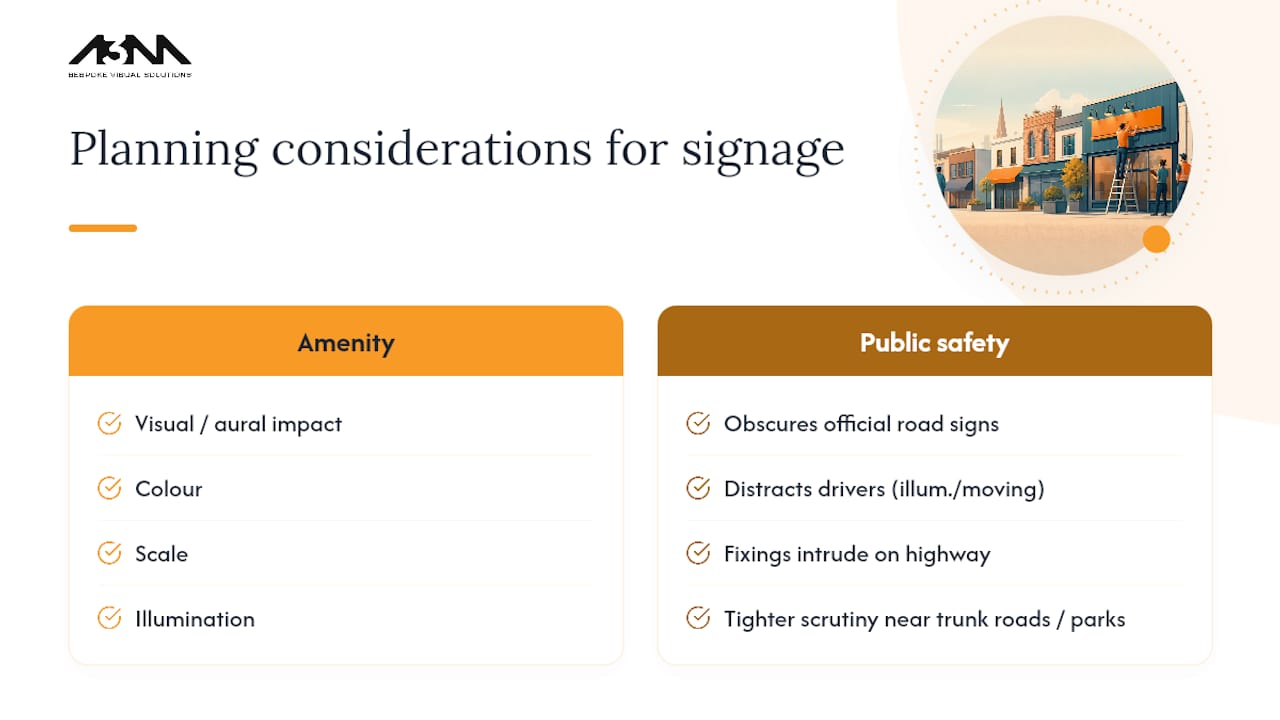
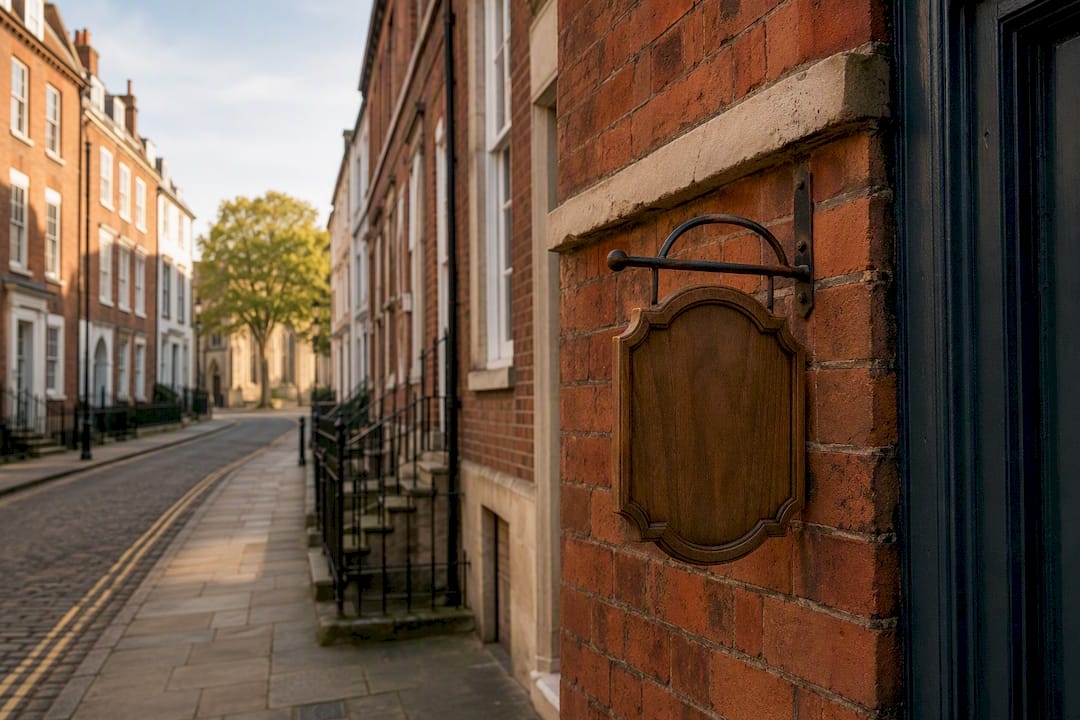
Amenity covers the visual and sometimes aural impact of a sign on its surroundings. A brash, oversized fascia sign on a listed Georgian building or in a designated conservation area is far more likely to be refused than the identical sign on a 1990s retail unit. Councils weigh colour, scale, illumination and materials against the character of the street.
Public safety is about whether the sign creates a hazard. Common objections include signs that obscure official road signs, illuminated or moving displays that distract drivers, or fixings that intrude onto a highway boundary. Signage near trunk roads, in National Parks, or within the Broads often faces tighter scrutiny for exactly this reason, and authorities can and do refuse consent purely on these grounds even when the design itself is inoffensive.
Your checklist for applying for advertisement consent
Get your paperwork right the first time and you cut weeks off the process. Councils reject or delay a striking number of applications simply because the submission is incomplete.
- Prepare a location plan showing the site in its wider context, plus a detailed site plan
- Draw scaled elevations of the proposed sign, including dimensions, materials and colours
- Specify illumination details if the sign lights up: type, brightness, hours of operation
- Confirm the proposed duration, particularly for hoardings or temporary event signage
- Secure written landowner permission before you submit, even if you’re the leaseholder
- Check highway authority involvement if the sign sits near a public road; local authorities hold powers under Section 132 of the Highways Act 1980 to remove unauthorised fixings on the highway
- Submit to the correct local planning authority, which under the 2007 Regulations must be the authority for the area where the advertisement will be displayed
Pro Tip: Book a pre-application chat with your local planning authority before you commission any artwork. Many councils will informally flag amenity concerns at this stage, saving you a redesign after a formal refusal.
If your premises is listed, or you’re working on a heritage high street, get a signage specialist involved early rather than after a refusal notice lands.
What happens if you get it wrong
Displaying an advertisement without the necessary consent is a criminal offence, not simply a civil planning matter. Local authorities can issue a discontinuance notice requiring removal of an existing sign even where it once had consent, if it’s now judged to cause harm to amenity or safety.
Where a sign is fixed unlawfully to a structure on the highway, the authority may remove it directly under the Highways Act, often at the owner’s cost. If you receive a notice, act quickly: gather your paperwork, establish whether retrospective consent is realistic, and consider whether relocating or resizing the sign resolves the objection faster than a formal appeal.
Refused applications carry a right of appeal to the Secretary of State, though this route typically takes months rather than weeks, so it’s rarely the fastest fix. Listed buildings add another layer of risk: even signage that would normally be exempt or deemed permitted needs separate listed building consent, and this is a frequent, expensive surprise for business owners who assumed the standard rules applied.
What A3m sees business owners get wrong on signage compliance
Most refusals we come across trace back to procurement shortcuts, not bad design. Before ordering, run a planning search, confirm landowner permission in writing, and prepare an installation method statement, particularly for anything fixed to a listed or historic building.
Design choices matter more than business owners assume:
- Sympathetic materials and finishes reduce amenity objections far more reliably than a smaller sign
- Proportionate lettering, scaled to the building rather than maximised for visibility, tends to sail through applications
- Low-level or timed illumination avoids the automatic scrutiny that full-brightness lighting attracts
- Discreet mounting details that don’t intrude onto a highway boundary avoid Section 132 disputes
Pro Tip: Ask any signage specialist you’re considering how many applications they’ve supported with your local authority specifically. Familiarity with a council’s particular sensitivities is worth more than generic planning knowledge. A3m’s work on compliant public sector signage reflects this same principle: design for the site’s constraints from the outset, not after a refusal.
The gap between planning theory and what actually gets refused
Most guidance treats advertisement consent as a binary compliance exercise: check the size, check the illumination, submit the form. That misses where the real risk sits. The two statutory tests, amenity and public safety, are judgement calls, and councils apply them with wildly different appetites depending on conservation status, local policy statements, and even which planning officer picks up the file.
Business owners who treat the 0.3 square metre threshold as the whole story get caught out precisely because deemed consent is conditional, not automatic. I’d argue the more useful mental model isn’t “is my sign under the size limit?” but “would this sign look at home on this specific street?” That’s a design question as much as a legal one, and it’s why the businesses that sail through applications tend to be the ones who involve someone with actual signage production experience before they draw up the artwork, not after a council objects to it.
The conventional advice to “check the Planning Portal and submit your form” is correct but incomplete. It skips the local policy statements that often matter more than the national default, and it under-weights how much a sympathetic material or fixing choice can neutralise an amenity objection before it’s even raised.
— Steve
Get your signage designed right the first time
Getting a planning application right the first time saves you weeks and the cost of a redesign after refusal. A3m works as the production partner that handles both sides of that problem: we design and manufacture signage built around your local authority’s amenity and safety concerns from the start, rather than leaving you to retrofit a rejected design.

Whether you need a fascia sign for a listed high street unit, hoardings for a development site, or a full wayfinding scheme across multiple premises, our signage service covers scaled drawings, material specification and illumination detail, the exact documentation your council will ask for. We also produce the technical drawings that support planning submissions; if your project needs bespoke fixtures alongside signage, our partner’s CAD drawing service is worth a look for accurate scaled plans. For construction and development sites, our guide to property development hoardings covers duration and application considerations specific to temporary signage.
Get in touch with A3m today for a quote on your signage project, and we’ll help you work out exactly what your local authority will need to see.
Sources
For the definitive rules, go straight to the Planning Portal’s adverts and signs guidance and Gov. The statutory text sits in the 2007 Regulations, with practical explanation in the outdoor advertisements booklet. Use your council’s website to find local policy statements before applying.
- Planning permission – Adverts and signs
- Outdoor advertisements and signs: a guide for advertisers
- The Town and Country Planning (Control of Advertisements) (England) Regulations 2007
- Do I need advertisement consent? — Planning House