

For most exhibitors, professional, exhibit-aware storage is the safest and most cost-effective way to keep stands show-ready between events. Self-storage only makes sense for small, low-cost items like banners and pop-ups. Here’s why the professional route wins for anything modular or custom-built:
- Graphic protection: climate control and proper hanging stop warping, delamination and colour fade.
- Lower repair costs: fewer reprints and panel replacements between shows.
- Simpler move-in: components arrive inspected, labelled and ready to build.
Your next step is straightforward: document a full intake inventory of your stand, then choose the storage option that matches its value and complexity.
Key Takeaways
Professional, exhibit-aware storage protects graphics and structural components, cuts repair and reprint costs, and keeps move-in predictable when providers manage it as active lifecycle care rather than static warehousing.
| Point | Details |
|---|---|
| Choose storage by asset value | Use exhibit-house storage for modular or custom stands; self-storage only for small, low-value items. |
| Document everything at intake | Photograph condition, log every component, and confirm portal access before handover. |
| Pack for the next build | Reverse-order packing with a setup diagram inside each case cuts delays at the next venue. |
| Book retrieval three weeks out | This window allows time for inspection, repairs and repacking before move-in. |
| Verify insurance and red flags | Confirm custody and transit cover in writing, and avoid providers without condition reporting. |
Table of Contents
- What professional exhibition stand storage actually covers
- Which storage option suits your exhibition stand?
- How do you pack and store an exhibition stand properly?
- How do you choose a good exhibition stand storage provider?
- What does exhibition stand storage cost and how far ahead should you book?
- A production partner’s view on stand storage
- Why treating storage as passive warehousing is a costly mistake
- Sources
What professional exhibition stand storage actually covers
A proper storage programme isn’t a lock-up with your name on the door. It’s active management of an asset that has to perform on demand.
Providers running a genuine service typically offer:
- Itemised intake with photographs and written condition notes for every panel, frame and case.
- Climate control, CCTV monitoring, and fire or pest protection built into the facility.
- Barcode or RFID tracking with a client portal showing where each item sits and when it’s due out.
- Pre-show staging, inspection and minor refurbishment before the stand ships.
Providers commonly run itemised intake with photos, condition reports, barcode or RFID tracking, and client portals precisely because exhibition assets move constantly and get handled by different crews each time. Without that paper trail, nobody can prove whether damage happened in transit, on site, or in storage. A well-run programme also schedules pre-show inspection and refurbishment into the storage window itself, so faults get fixed while the stand is idle rather than discovered the morning of move-in.
Which storage option suits your exhibition stand?
Three models dominate the market, and each carries a different balance of cost, risk and effort.
- Exhibit-house storage — the builder or a specialist exhibition storage partner holds your stand, usually with climate control, inventory tracking and pre-show prep bundled in.
- Commercial warehouse storage — general-purpose logistics space, sometimes climate-controlled, but rarely staffed by people who understand exhibition hardware.
- Self-storage units — cheap, flexible, and suitable only for small or low-value kit.
The trade-offs break down like this:
- Exhibit-house storage costs more monthly but protects graphics, LEDs and fabricated structures properly, and it usually includes reassembly support.
- Commercial warehousing sits in the middle: reasonable environmental control, but you handle inventory and prep yourself.
- Self-storage is the cheapest option upfront, yet modular and custom exhibits risk warping, delamination and LED failures without proper humidity and temperature control.
Choose exhibit-house storage for anything custom-built or graphics-heavy. Commercial warehousing works for simple modular kits with in-house handling capacity. Reserve self-storage for banners, pop-ups, and low-value literature stands.
How do you pack and store an exhibition stand properly?
Teardown is where most damage happens, not transit. Rushed packing at 11pm on the last day of a show is how frames get scratched, cables go missing and graphics crease. Follow a consistent sequence every time.
- Photograph everything before packing. Capture condition on every panel, frame joint and lighting rig while it’s still on the show floor.
- Pack in reverse setup order. The last thing you’ll need to install first should sit on top of the case.
- Tape a setup diagram inside each case lid. Packing in reverse order with a diagram inside the case prevents build delays at the next venue, because nobody has to guess which bracket goes where.
- Bag and label every fixing. Screws, connectors and brackets go into labelled bags, taped directly to their parent component, not loose in a box.
- Handle graphics correctly. Roll fabric graphics on cores rather than folding them, and store rigid panels flat or vertical in foam-lined cases, never leaning under weight.
- Check electrical components at intake. Remove and label power supplies, and test LED drivers before they go into storage, not the night before the next show.
- Build a master manifest. List every structural piece, graphic panel, hardware bag and case number, with a photo per box where possible.
Pro Tip: Keep a laminated copy of the setup diagram inside every case and a digital copy in your storage provider’s portal. If a case goes astray, you can rebuild from the diagram alone.
How do you choose a good exhibition stand storage provider?
Ask direct questions before signing anything. A provider’s answers here tell you more than their brochure ever will.
- What does your intake procedure look like, and do I get an itemised condition report with photos?
- Is there a web portal so I can check inventory and shipment status myself?
- What are your climate-control specs, and do you have sprinklering, fire suppression and CCTV in place?
- Can you refurbish or repair panels in-house, and what’s your lead time for pre-show staging?
- How is pricing structured, cubic footage or service tier, and are there minimum terms or notice periods?
- What’s covered under your insurance while my stand is in your custody or in transit, and what’s excluded?
Red flags are easy to spot once you know what to look for: no condition reporting at intake, vague or verbal insurance assurances, and no offer of pre-show inspection. If a provider can’t answer the portal or insurance question clearly, treat that as a decision point, not a detail to chase later. Where you’re relying on public reviews to shortlist providers, check how those reviews are collected and verified, since platform review policies vary and case studies or direct references tell you more than a star rating.
What does exhibition stand storage cost and how far ahead should you book?
Monthly storage costs vary mainly with size, whether climate control is included, and how much service sits on top of basic space. A small modular kit in unclimatised warehouse space costs far less than a large custom stand in a fully monitored, climate-controlled facility with inventory management and portal access.
Timing matters just as much as price. Requesting your storage pull at least three weeks before move-in gives enough runway for inspection, minor repairs and repacking. Compress that window and you’re paying for rush shipping or emergency repairs instead.
A few cost drivers worth flagging:
- Climate-controlled space and service-level extras (staging, inspection, refurbishment) push monthly rates up.
- Exhibit-house storage often costs more per month but lowers total cost of ownership by avoiding repeat repair and reprint spend.
- Insurance matters in both directions: check declared-value cover for transit and separate custody limits while the stand sits in storage.
- Emergency pulls with short notice typically carry a premium over standard retrieval lead times.
A production partner’s view on stand storage
Storage works best when it’s part of the same process that built the stand. A3m’s bespoke exhibition stand builds are designed with reassembly and repair in mind from the outset, and our Vector service supports that lifecycle between shows.
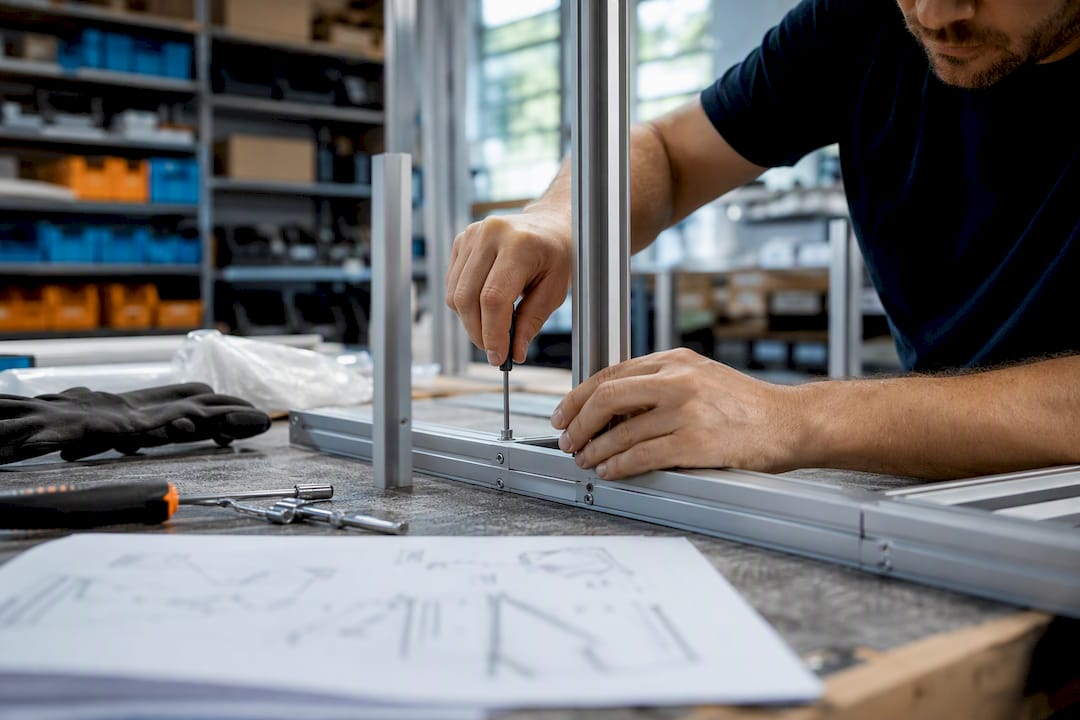
An integrated partner cuts the number of handoffs between build, storage and staging, which shortens pre-show lead times. When you commission a stand, ask your builder for a proper handover pack: full inventory, setup diagrams, and maintenance notes for hardware and graphics.
Why treating storage as passive warehousing is a costly mistake
Most exhibitors still think of storage as a place to put things, not a process that protects them. That’s the real gap in how this topic gets handled. A stand isn’t a static object between shows; it’s a set of materials that degrade, hardware that loosens, and electronics that fail quietly if nobody checks them.
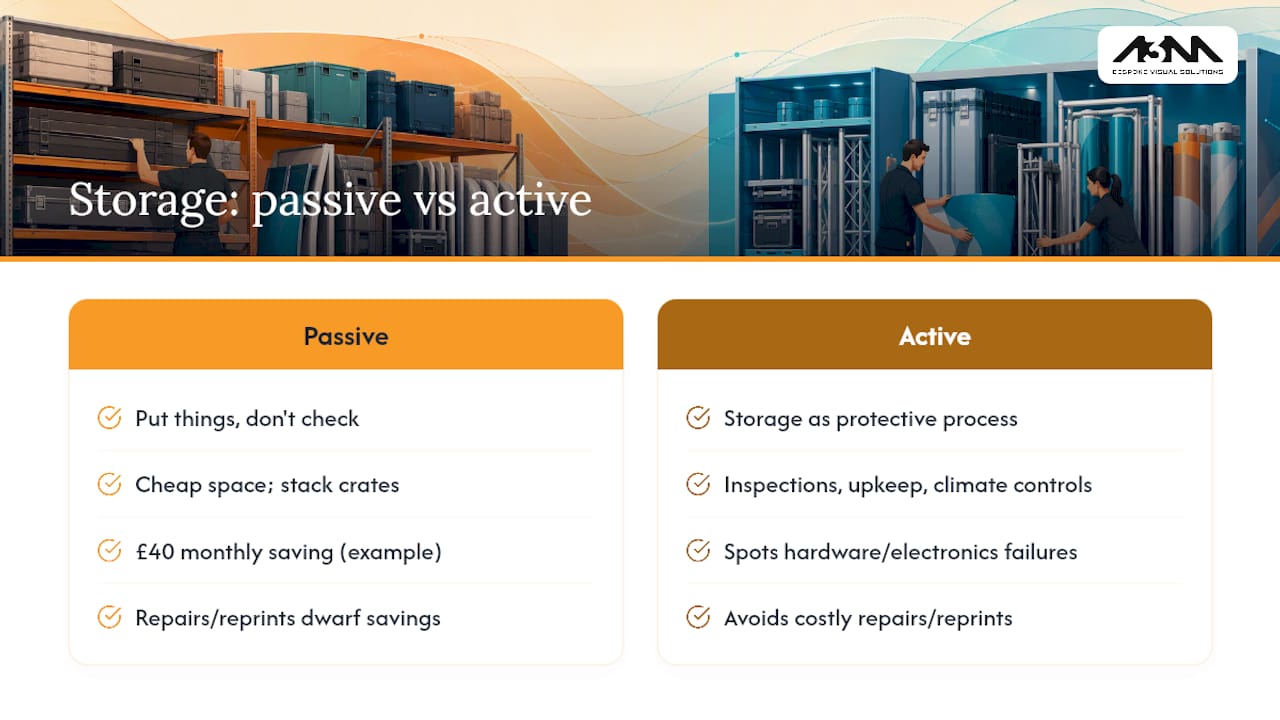
The conventional advice, find cheap space and stack the crates, ignores the fact that repair and reprint costs almost always dwarf the storage saving. A £40 monthly difference between a basic unit and a climate-controlled facility means nothing next to a £2,000 graphic reprint caused by damp.
What should you prioritise first? Documentation. Not the fanciest facility, not the smartest barcode system, just a clear photographic and written record of what you own and what condition it’s in. Everything else, climate control, portals, pre-show staging, only works once you know exactly what you’re protecting. Get that right and the rest of the decision becomes far easier.
— Steve
Sources
- Trade show storage: How to store your exhibit between shows
- Exhibition storage guide: How to store stands & displays between shows