

Carbon-balanced printing means calculating the CO2 for a specific print job and funding verified conservation projects to offset the residual emissions. Two credible UK routes handle this: World Land Trust’s Carbon Balanced Paper scheme and the BPIF’s ClimateCalc route towards CarbonNeutral® certification. Before you approve any job, ask your supplier for the job’s carbon footprint figure and the certificate that proves it was balanced.
TL;DR:
- Both World Land Trust’s Carbon Balanced Paper and BPIF’s ClimateCalc schemes target different levels, with the former focusing on individual jobs and the latter on ongoing business operations.
- Certificates from these schemes specify the project funded, the CO2 figure, and proof of payment, which are vital for tender and sustainability reporting.
- The cost of carbon balancing usually includes a small surcharge, with the World Land Trust calculator setting a minimum of £5 plus VAT for a direct job offset.
- Procurement teams should verify certificates’ details, project location, and external certification to ensure credibility and support sustainability claims.
- Collect and retain all carbon-offset documentation alongside other compliance evidence, and ask suppliers specific questions to expose weak offsetting claims.
Table of Contents
- What is carbon offset printing UK buyers actually pay for?
- How is carbon balancing evidenced, and why do tenders care?
- How much does carbon-balancing a print job cost?
- Step-by-step: ordering a carbon-balanced print job
- Which questions expose a weak carbon-offsetting claim?
- How A3M builds carbon balancing into a print job
- Get a carbon-balanced quote from A3M
- Where to check the detail yourself
- Sources
What is carbon offset printing UK buyers actually pay for?
A job-level carbon footprint covers the paper stock, ink, energy used in production and, often, transport to your delivery address. What it typically excludes is your own onward distribution and any digital proofing overhead, so ask your supplier exactly where the boundary sits before comparing quotes.
Two schemes dominate the UK market, and they solve different problems.
- World Land Trust’s Carbon Balanced Paper works at job level. Its public carbon calculator lets a business balance a single print run directly, generating a certificate and logo for that specific job.
- BPIF’s ClimateCalc, paired with CarbonNeutral® certification, operates at printer level. A supplier measures its whole site’s emissions, then certifies the business as carbon neutral on an ongoing basis rather than job by job.
Both matter for procurement, but for different reasons. A job certificate proves this specific order was balanced. A site-level programme tells you the printer takes emissions seriously across everything it produces, which is worth knowing if you’re placing repeat orders through a web-to-print portal. World Land Trust has registered more than 3,000 brands and organisations through Carbon Balanced Paper since the programme began, which gives you a fair idea of how established the route has become.
How is carbon balancing evidenced, and why do tenders care?
You need paperwork, not promises. A World Land Trust job certificate names the project location, states the standard used, and confirms the tonnage of CO2 balanced for that specific run. CarbonNeutral® certification, delivered through The CarbonNeutral Company via the BPIF route, works similarly but applies to the whole print business rather than a single job.
When a certificate lands on your desk, check three things:
- Does it name the specific project funded, not just a generic “carbon offset portfolio”?
- Does the CO2 figure match the volume and weight of the job you actually ordered?
- Is there an invoice or transaction receipt behind the certificate, proving money genuinely moved to the offset project?
These documents aren’t just filing cabinet fodder. Procurement teams increasingly expect ISO 14001, FSC and PEFC as a baseline in tender scoring, and a job-level carbon certificate strengthens your sustainability case further still. The World Land Trust logo and certificate are designed to be used exactly this way, in tender submissions and annual sustainability reports.
Pro Tip: Keep every carbon certificate in the same folder as your ISO 14001 evidence. Tender assessors often want both in one submission, and hunting through separate email threads under deadline pressure is a mistake worth avoiding.
For higher-scrutiny procurements, ask whether the specific offset project carries external verification, such as VCS or CCB standards. Some World Land Trust portfolio projects are managed internally without that extra layer of third-party audit, which is fine for most commercial reporting but worth flagging if your organisation’s own governance demands it.
How much does carbon-balancing a print job cost?
Most UK printers add a modest surcharge to the job price rather than charging a separate invoice line, which keeps quoting simple but can obscure exactly what you’re paying for. Ask your supplier to itemise it anyway. Transparency here matters more than the pound figure, because it lets you compare like for like across quotes.
World Land Trust’s own public calculator carries a minimum transaction fee of £5.00 plus VAT for balancing a single order directly, which gives you a useful floor when sanity-checking a supplier’s pricing.
Don’t assume “sustainable” automatically means “more expensive”. Some printers pair emissions reduction, better material yield, tighter waste control, with offsetting, and pass the net saving on rather than stacking a surcharge on top of business as usual. To get an accurate price, your supplier needs the paper grade and GSM, run length, finishing specification, and delivery postcode. Without that data, any quoted figure is a guess dressed up as a number.
Step-by-step: ordering a carbon-balanced print job
Getting this right doesn’t require a sustainability department. It requires four steps, done in order, before you sign off the job.
- Gather your job data first. Paper grade, GSM, quantity, finish, and delivery postcode all feed the carbon calculation, so have them ready before you request a quote.
- Request the job-level footprint and certificate before approval, not after the job has printed. Ask specifically whether you’ll receive a World Land Trust certificate or a CarbonNeutral®-linked figure.
- Confirm the project and payment evidence. A credible supplier can point to the specific offset project funded and show that a transaction actually took place.
- Retain the certificate and logo usage terms. File them alongside your other tender and reporting evidence, ready to reuse the next time you bid for work that scores on sustainability credentials.
Pro Tip: Ask for the certificate to be issued in your organisation’s name, not the print supplier’s, if you plan to quote it in your own sustainability reporting or client pitches.
Which questions expose a weak carbon-offsetting claim?
Some suppliers talk a good game on sustainability without much behind it. A short set of direct questions usually separates the credible ones from the vague ones.
Ask which calculator or methodology they use, and whether it’s a recognised route such as World Land Trust or BPIF ClimateCalc rather than an in-house estimate with no external reference point. Ask which specific project your offset payment funds, and request proof of the transaction, not just a logo on the invoice. Ask what sits inside their cradle-to-gate assumptions, because a supplier that can’t explain what’s included in their own footprint figure probably hasn’t calculated it properly.
Watch for these warning signs:
- No certificate offered at all, just a claim of being “carbon neutral” with nothing to show for it.
- Vague project descriptions (“we support reforestation”) with no location, standard, or verifiable link.
- Reluctance to produce an invoice or receipt proving the offset payment was actually made.
A supplier confident in its process will hand over documentation without hesitation, usually within a day or two of the job being confirmed. Hesitation or deflection is the clearest signal something doesn’t add up.
How A3M builds carbon balancing into a print job
A3M gathers the job data (paper grade, quantity, finish, delivery) at quoting stage and coordinates balancing through the World Land Trust route, or recommends Carbon Balanced Paper stock where it suits the brief. Certificates and logo usage terms are handed over ready for your reporting or tender submission. Pairing efficient production with offsetting, rather than treating them as separate costs, keeps the total charge realistic and gives procurement teams a defensible answer when asked how a job’s footprint was addressed.
— Steve
Get a carbon-balanced quote from A3M
A3M is the practical route for UK organisations who want carbon-balanced print handled by the people already producing the job, rather than bolted on as a separate process afterwards. Our sustainable print capability sits alongside large format, exhibition, and signage production, so whether you need bespoke exhibition stands for a trade show or wayfinding for a retail rollout, the carbon conversation happens in the same quote, not a separate one.

When you get in touch, send your paper grade, quantity, finish, and delivery postcode upfront. That’s enough for us to price the job accurately and confirm whether a World Land Trust certificate or a CarbonNeutral®-linked figure fits your reporting needs. Our sustainable print procurement guide walks through the same checklist in more detail if you’re preparing a tender submission. Get in touch with your job specification and we’ll come back with a carbon-balanced quote alongside the standard price, so you can compare both before you commit.
Where to check the detail yourself
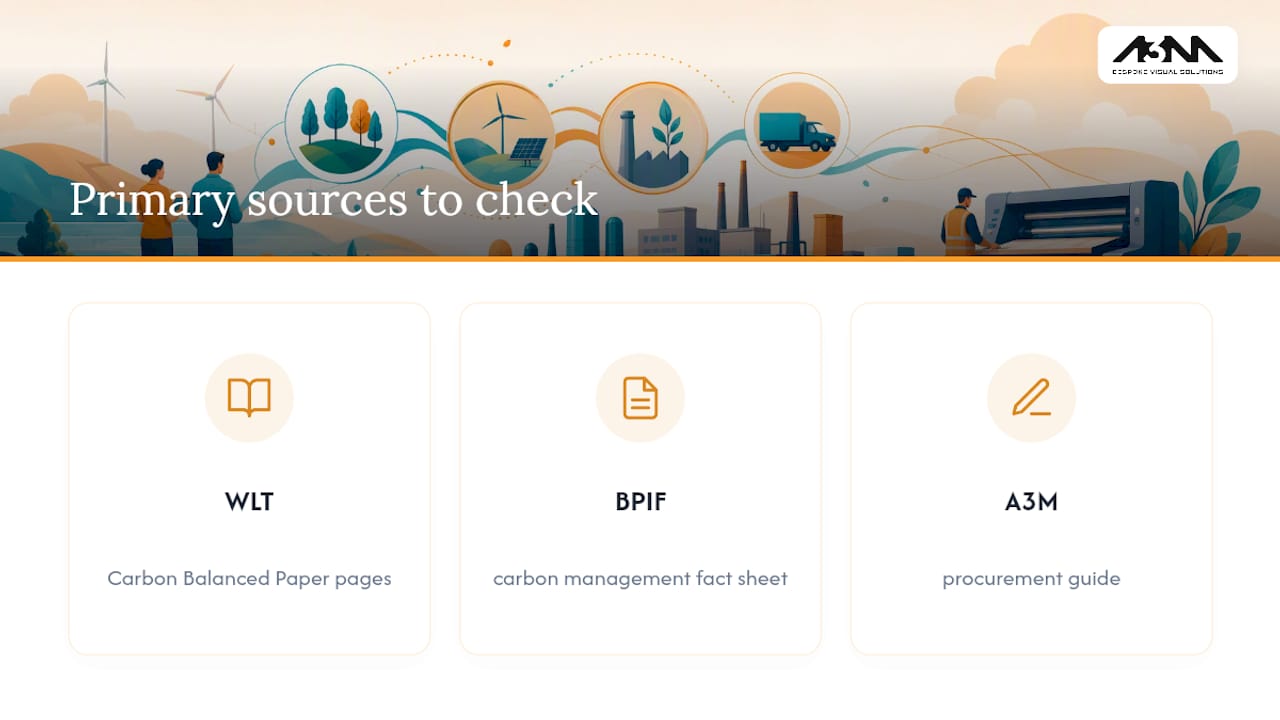
For primary detail, see World Land Trust’s Carbon Balanced Paper pages, the BPIF carbon management fact sheet, and A3M’s own procurement guide.
Sources
- Carbon Balanced Paper – World Land Trust
- Public Carbon Calculator – Carbon Balanced Paper
- Carbon footprinting calculator – British Printing Industries Federation (BPIF)