

Standardised signage systems cut wayfinding errors, lower operational costs, improve safety and protect brand consistency across sites. That’s the short version. For estates and facilities teams weighing up whether a formal signage standard is worth the procurement effort, the evidence is fairly blunt: unclear signage generates avoidable staff time, missed appointments and inconsistent brand experiences, and the fix is a documented, repeatable system rather than a one-off design job.
A hospital wayfinding study found that after signage standardisation, dependency on help desks fell and patient experience scores rose, with 84% of participants recommending digital signage as part of the improved system. That single data point tells you something most signage briefs miss: this isn’t a decoration problem, it’s an operations problem.
The core benefits, in order of what tends to matter most to the people paying for the rollout:
- Wayfinding — visitors and patients reach their destination without asking staff.
- Safety and compliance — regulatory and emergency signage is legible, consistent and meets accessibility standards.
- Operational efficiency — fewer front-desk interruptions, less staff time spent giving directions.
- Brand consistency — every site or ward looks and reads like the same organisation.
- Maintainability — shared components mean faster repairs and simpler spares management across an estate.
The NHS treats effective wayfinding as a core element of the environment of care, not an optional finishing touch. If you manage signage across more than one site, that framing is worth adopting before you write a single spec.
Key Takeaways
Standardised signage systems reduce staff direction time, cut missed appointments and lower long-term maintenance cost by replacing site-by-site variation with one governed specification.
| Point | Details |
|---|---|
| Core benefits are measurable | Track helpdesk enquiries, guidance time per visitor and appointment no-shows before and after rollout. |
| Governance comes before design | Appoint a signage manager, write a standards document, and enforce change control from day one. |
| Progressive disclosure reduces stress | Reveal only the next decision point rather than full directories at every junction, especially in healthcare settings. |
| Standardised components cut repair time | Shared fixings and a documented spares list mean faster, cheaper fixes across an entire estate. |
| A3m supports full-scale rollouts | In-house manufacturing, modular components, installation teams and web-to-print portals help maintain one standard across multiple sites. |
Table of Contents
- What are the benefits of standardised signage systems for multi-site estates?
- What are the core benefits of a signage standard in practice?
- What should a signage standard actually cover?
- How do you roll out a standardised signage system?
- Modular or digital signage: which fits a standardised system?
- What does the research actually show?
- How do you maintain a signage system once it’s live?
- What should you expect from a signage manufacturing partner?
- What do signage professionals get wrong most often?
- How A3m supports standardised signage rollouts
- Frequently asked questions
- Sources
What are the benefits of standardised signage systems for multi-site estates?
The organisational value of a signage standard comes from removing variation, not from any single sign looking better. When every site designs its own directory, names its own zones and picks its own typeface, every new starter, locum, or first-time visitor has to relearn the system from scratch. That relearning cost is invisible on a balance sheet but real in every shift.
Poor wayfinding has a hidden cost structure. Staff time spent redirecting lost visitors is the obvious one, but delayed arrivals also cause missed appointments, and in larger buildings, confused visitors heading into restricted areas can trigger security responses that a clear regulatory sign would have prevented. None of this shows up as a line item labelled “signage failure” on a budget report. It shows up as staff overtime, appointment no-shows and security incident logs, and it’s rarely traced back to its actual cause.
NHS guidance on hospital wayfinding recommends progressive disclosure as a governing principle: reveal only the next decision a visitor needs to make, rather than presenting a full directory at every junction. This matters more than it sounds. A stressed relative looking for an intensive care ward doesn’t need to see forty department names at the entrance. They need one clear sign pointing them to the next decision point. Standardising this principle across a building, and across every building in an estate, is what actually reduces staff interruptions.
Here’s a concrete example of what that looks like in practice. A facilities team that replaces an ad hoc noticeboard directory with a standardised, hierarchy-led floor directory typically sees front-desk enquiries about basic navigation drop within weeks, simply because visitors stop needing to ask. That’s a measurable, trackable outcome, and it’s the kind of metric worth baselining before a rollout starts so you can prove the return afterwards.
What are the core benefits of a signage standard in practice?
Each of the five headline benefits translates into something you can actually measure, not just something that sounds good in a strategy document.
Wayfinding means visitors self-navigate without staff intervention. Track it through average guidance time per visitor or the number of “where is…” enquiries logged at reception.
Safety and compliance covers fire, emergency and regulatory signage that meets legibility and accessibility standards consistently across every site. Track it through audit pass rates and the age of the newest fire safety sign against the oldest.
Operational efficiency is the sum of reduced staff direction time and fewer missed appointments caused by late or lost visitors. Track it through helpdesk query volume and appointment no-show rates before and after a rollout.
Brand consistency means a visitor at site three recognises the same visual language they saw at site one. For multi-location brands, locking the visual attributes that matter most for recognition — colour, logo placement, legibility — while allowing local technical flexibility for mounting and access, is what makes a standard scalable rather than rigid.
Maintainability is the quiet one that saves the most money over a ten-year estate lifecycle. Shared components, shared fixings and a documented spares list mean a damaged sign at any site can be repaired from the same stock, rather than triggering a bespoke reorder.
Pro Tip: Adopt a consistent zone-naming and numbering convention before you commission any artwork. A signage standard that names one wing “East Wing” and another “Wing B” for the same function across sites will quietly undermine every other benefit on this list, because staff and visitors start distrusting the system itself.
What should a signage standard actually cover?
A specification that’s genuinely ready for procurement needs to define both the sign types in the system and the design rules that govern them. Skipping either leaves gaps that a supplier will fill with assumptions, and assumptions are exactly what standardisation is meant to eliminate.
- Directional signs — arrows and route markers placed at genuine decision points, following the progressive disclosure principle rather than dense, all-in-one directories.
- Identification signs — room numbers, department names and ward labels, consistent in format across every building in the estate.
- Informational signs — opening hours, safety notices, general guidance that doesn’t require a decision from the reader.
- Regulatory signs — fire exits, accessibility markers, statutory notices that must meet specific legibility and placement rules under building and fire safety regulation.
- Directories — used sparingly, at entrances only, and designed to hand off to directional signage rather than replace it.
Beyond the sign types, the rules that make a system genuinely standardised include a fixed typography scale linked to viewing distance, minimum contrast ratios for legibility, a consistent icon set, a clear language policy for multilingual sites, defined mounting heights, and a documented message hierarchy that dictates what gets priority billing on any given panel. A peer-reviewed review of healthcare signage design links well-designed signing directly to reduced stress and improved safety outcomes, which is a strong argument for treating these rules as non-negotiable rather than aspirational.
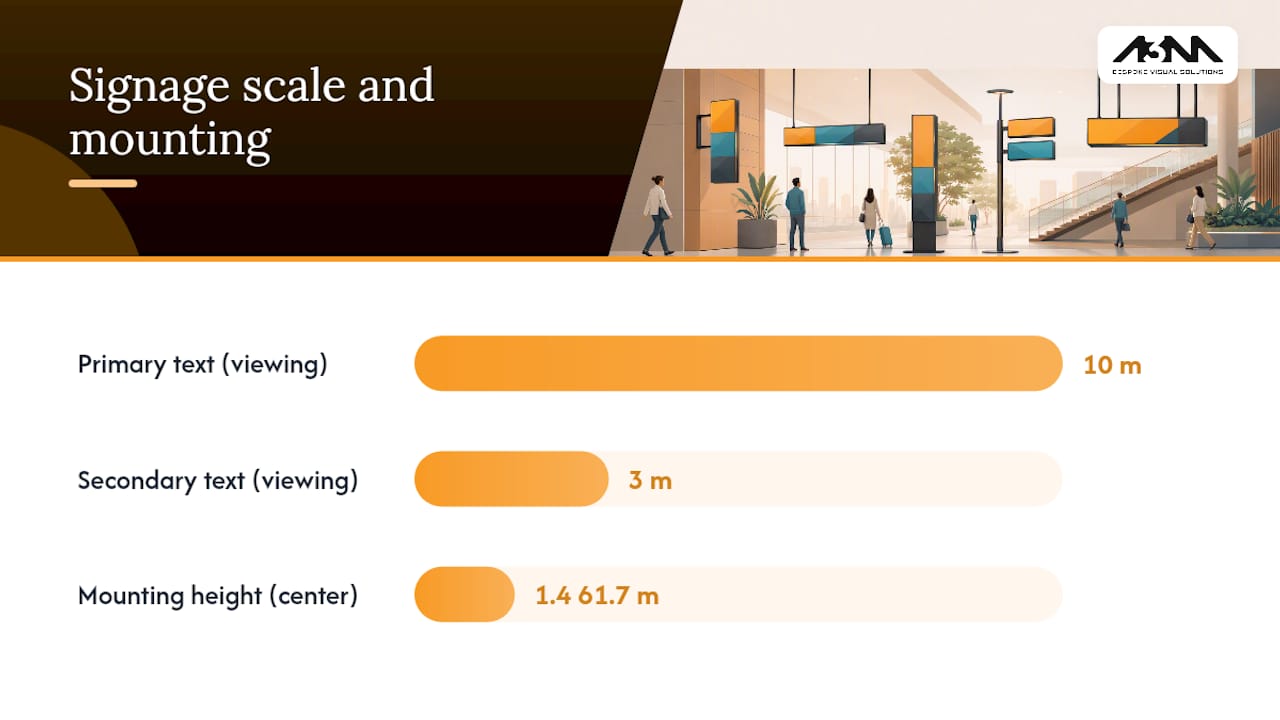
A workable spec snippet might read: primary directional text sized for a 10 metre viewing distance, secondary text for 3 metres; mounting height of 1.4 to 1.7 metres to centre for accessibility; message hierarchy running location name, then directional arrow, then supplementary information, in that fixed order on every panel. Environmental graphics should support this hierarchy rather than compete with it. Brand graphics belong only where they reinforce orientation or mark a genuine transition point, not scattered decoratively along a corridor. Our own wayfinding signage design guide walks through message hierarchy in more depth if you’re drafting a brief from scratch, and our guide to indoor directional signage covers placement rules for facility managers working through a floor-by-floor spec.
How do you roll out a standardised signage system?
Governance comes first, before a single sign is fabricated. Appoint a signage manager or single point of accountability, produce a written standards document that covers every rule from Section 4, and put a change control process in place so a well-meaning site manager can’t quietly commission an off-brand sign six months after launch. The VA Signage Design Manual recommends exactly this: a formal signage system standard maintained alongside a sign data register, so every asset across an estate is tracked, dated and traceable back to a single specification.
Rollouts on multi-site or hospital estates typically move through four phases, and trying to compress them rarely ends well.
| Phase | What happens | Typical timescale |
|---|---|---|
| Audit | Survey existing signage, map wayfinding pain points, log every current asset | 2 weeks per site cluster |
| Pilot | Standard applied to one representative site, tested with real visitors and staff | 4 weeks |
| Phased rollout | Standard applied estate wide, prioritised by highest need or highest footfall | several months depending on estate size |
| Handover and maintenance | Sign data register finalised, spares stock established, maintenance workflow live | Ongoing |
Procurement conversations should push suppliers on specifics, not just price. Ask for physical samples of proposed materials, a full spare-parts list tied to the specification, and a clear statement of how the supplier handles site-specific adaptations without breaking the standard. A tender that can’t answer these questions in writing usually means informal adaptation later, which is how brand drift creeps back in.
The main cost drivers, roughly in order of impact on a typical multi-site budget:
- Fabrication volume and material choice, particularly for illuminated or metal-faced signs.
- Site surveys across a dispersed estate, especially where access is restricted or listed building consent applies.
- Landlord or planning approvals, which can stall a phase for weeks on leased sites.
- Digital screen hardware and content management licensing, where a hybrid system is chosen.
Modular or digital signage: which fits a standardised system?
Modular physical signage, where interchangeable insert panels sit inside a fixed frame, is the strongest option for organisations that update department names, staff lists, or wayfinding text more than once every few years but not constantly. A single frame design gets fabricated once across the whole estate, and updates become a matter of reprinting an insert rather than commissioning a whole new sign. Spares management becomes trivial because every site holds stock of the same insert dimensions.

Digital signage earns its cost where content genuinely needs to change often, such as clinic schedules, event listings, or multi-message rotating panels in a busy reception. The trade off is real: screens carry ongoing power and lifecycle costs, and without proper content governance, a digital panel can become the exact inconsistency problem a standard was built to solve, with different sites running different fonts, colours and message formats on their own initiative. Content management approaches for digital signage exist specifically to prevent this drift by locking templates centrally while allowing local content updates.
Most multi-site estates land on a hybrid: modular physical signage for stable wayfinding and identification, digital screens reserved for genuinely dynamic information. Our digital signage page covers the practical side of content management for exactly this kind of mixed estate.
Pro Tip: If you’re adding screens to a physical signage estate, write the content governance rules into the same standards document as the fabricated signage. Treat “who can update this screen and with what template” as seriously as you treat mounting heights, because a badly governed screen undoes brand consistency faster than any single bad physical sign.
What does the research actually show?
The evidence base for signage standardisation is stronger in healthcare than almost anywhere else, largely because hospitals have measured the cost of getting it wrong for decades.
- A hospital signage study recorded improved accessibility and reduced dependence on staff-led direction after standardisation, alongside specific participant feedback: 84% wanted more digital signage, 33% wanted better sign placement, and 13% wanted larger signage.
- A peer-reviewed literature review found that well-designed healthcare signing reduces stress and improves safety for both patients and staff, which reframes signage as a clinical safety tool rather than a facilities afterthought.
- NHS guidance positions wayfinding as core to the environment of care, meaning signage decisions sit alongside clinical layout decisions rather than beneath them in priority.
A large hospital that standardised its signage estate and applied progressive disclosure principles at every junction saw a reduction in help desk dependency, matching the pattern reported in the peer-reviewed study above. That’s the kind of measured outcome worth quoting in an internal business case, because it ties a design decision directly to a staffing cost.
None of this means a standard designed for one hospital estate transfers perfectly to another. Local testing matters. What counts as an intuitive icon or an obvious decision point varies by building layout and visitor demographic, so piloting the standard on one site before estate-wide rollout, exactly as the phased timeline above suggests, isn’t a bureaucratic delay. It’s how you catch the local exceptions before they become embedded across forty sites.
How do you maintain a signage system once it’s live?
A standard that isn’t maintained decays back into the inconsistency it was built to fix, usually within two or three years. Build a maintenance workflow before the first sign goes up, not after the first complaint comes in.
- Schedule regular inspections against the sign data register, checking for damage, fading and outdated information.
- Hold spare-part stock matched to the standardised components across the estate, not per site.
- Define a clear update process: who requests a change, who approves it, who fabricates and installs it.
- Keep the sign data register current every time an asset is added, moved or retired.
- Choose materials for longevity and end-of-life recyclability, particularly for exterior and high-traffic interior signage.
Standardised components genuinely reduce reactive maintenance. When every site runs bespoke hardware, spare parts can’t be shared and repairs take longer and cost more, because a technician has to source or fabricate a one-off replacement rather than pulling from shared stock. The VA manual’s own lifecycle guidance points to a typical 10 to 15 year lifespan for interior signage components, and standardisation is what lets an estate plan replacement cycles in bulk rather than reactively, site by site.
Material choice affects both cost and environmental impact over that lifecycle. Durable, recyclable substrates reduce landfill waste at end of life and typically survive UK weather conditions better on exterior applications, cutting the frequency of full replacement. Our guide to sustainable signage materials covers the trade-offs between material longevity and environmental footprint in more depth. Digital signage carries its own lifecycle consideration too: screens have a shorter functional life than fabricated panels and carry embedded manufacturing impact that a static sign doesn’t, which is worth factoring into a hybrid system’s total cost of ownership.
What should you expect from a signage manufacturing partner?
A supplier capable of delivering a standardised rollout across multiple sites, rather than just fabricating individual signs to order, should bring more than a price list to the table. Expect a proper site survey process that captures existing conditions before design begins, a sign data management system that tracks every asset against your standard, modular manufacturing capability that can produce shared components at scale, dedicated installation teams who understand phased rollout logistics, and a warranty or maintenance plan that covers the estate rather than individual signs in isolation.
A multi-site rollout managed well typically shows up in outcomes rather than paperwork: consistent lead times across every site phase, no unexplained variation in materials between locations, and a spares inventory the client can actually draw on two years after handover rather than reordering bespoke parts each time. That’s the practical test of whether a supplier understood the brief as a system rather than a series of one-off jobs.
When drafting tender documents, ask suppliers for physical material samples rather than digital renders, a documented spare-parts list tied to the exact specification, and a clear written policy on how they handle site-specific adaptations, such as an unusually shaped reception or a listed building’s mounting restrictions, without quietly deviating from the agreed standard. Suppliers offering modular exhibition and signage manufacturing at scale should be able to answer all three without hesitation.
What do signage professionals get wrong most often?
The biggest procurement mistake isn’t choosing the wrong material or the wrong typeface. It’s treating the standards document as a design deliverable rather than a governance tool. A beautifully produced brand guideline that nobody on-site actually consults becomes shelf-ware within a year, and the estate drifts straight back to inconsistency.
Do involve clinical and front-line staff early, particularly in healthcare settings. They know exactly where visitors get lost, because they’re the ones fielding the questions every day, and their input catches wayfinding failures that a design review in a boardroom never will. Don’t sign off a full estate rollout based on a single pilot site without genuinely stress-testing it with real, unbriefed visitors. A pilot that only gets walked through by the project team proves nothing about how a confused, time-pressured visitor actually reads the signage.
Training and communication matter more than most rollout plans allow for. Staff need to understand the new naming conventions and zone numbering as much as visitors do, and a launch that skips a short briefing session for reception and ward staff tends to see the old informal directions creep straight back in, undermining the standard within weeks. Stakeholder engagement isn’t a box to tick before sign-off. It’s the mechanism that keeps a standard alive once the installation team has left site.
How A3m supports standardised signage rollouts
If you’re planning a multi-site or hospital-scale signage standard, the practical challenge usually isn’t the design brief. It’s finding a partner who can manufacture consistently across dozens of locations, manage phased installation without disrupting daily operations, and keep a spares register that actually works two years after handover. A3m’s in-house manufacturing means fabrication, modular components and installation sit under one roof, rather than being juggled across separate contractors who each interpret your specification slightly differently.

Our signage services cover directional, identification, regulatory and informational signage manufactured to a single specification, alongside digital signage and display integration for estates running a hybrid system. For organisations managing signage requests across multiple sites, our web-to-print portals let local teams order pre-approved, on-brand signage without touching the master specification, which keeps the standard intact without bottlenecking every request through a central design team.
If you’re at the audit or pilot stage of a rollout and want to talk through fabrication options, spare-part planning or a phased installation schedule, get in touch to request a site survey and a proper quote against your specification.
Frequently asked questions
What are the main benefits of standardised signage systems?
The principal benefits are improved wayfinding, stronger safety and compliance, lower operational cost through reduced staff direction time, consistent brand presentation across sites, and simpler long-term maintenance through shared components.
Why does standardised signage reduce errors?
It removes the local variation that causes confusion. When every site uses the same typography, colour coding, icon set and message hierarchy, visitors don’t have to relearn the system at each location, which cuts misdirected visits and missed appointments.
How much does a multi-site signage rollout typically cost?
Cost depends heavily on fabrication material, estate size and whether digital screens are included, but the main drivers in order of impact are fabrication volume, site surveys, landlord or planning approvals, and digital hardware. A phased rollout lets you spread this cost across a defined timeline rather than funding it all upfront.
Is digital signage worth it for a standardised system?
It’s worth it where content changes frequently, such as appointment schedules or event listings. For stable wayfinding and identification signage, modular physical panels are usually more cost-effective and require less ongoing governance than a screen network.
How long does a signage standard last before it needs updating?
Physical signage components typically last around 10 to 15 years with proper maintenance, though a brand refresh or major estate change can shorten that. A documented sign data register makes it far easier to plan replacement cycles rather than reacting site by site.
Sources
- Wayfinding: effective wayfinding and signing systems guidance for healthcare facilities — NHS England
- Implementation of wayfinding signage in public hospitals and its evaluation towards quality improvement — PMC
- Healthcare signage design: a review on recommendations for effective signing systems — SAGE Journals
- VA Signage Design Manual